A Mortgage Broker in Lancaster can help turn a property decision into a financial decision that makes sense for your circumstances.
You may choose a home for its street, space, character, or proximity to work. A lender sees something different. It considers affordability, deposit, income, credit history, property type and whether the application fits its criteria.
Lancaster makes that distinction particularly important. Its housing market includes flats, traditional terraces, family homes and larger detached properties, alongside a rental sector influenced by the city’s universities.
According to the Office for National Statistics, the average Lancaster house price was £203,000 in July 2026, up 4.9% from a year earlier. The average price paid by a first-time buyer was £181,000.
At a Glance
Lancaster combines comparatively accessible first-home prices with varied housing and an established private-rental market. Your deposit, income structure, property type and intended use can all affect lender choice. A suitable mortgage adviser can assess those factors together rather than looking at the mortgage rate in isolation.
Lancaster’s Mortgage Market Is More Varied Than One Average Suggests
A single Lancaster house-price figure hides a considerable range of property values.
ONS figures for July 2026 recorded average Lancaster prices of:
- Detached homes: £348,000
- Semi-detached homes: £226,000
- Terraced homes: £182,000
- Flats and maisonettes: £116,000
That difference matters when arranging a mortgage.
Someone buying a city flat may face leasehold and service-charge questions. A buyer looking at an older terrace may need to consider the property’s construction, condition and valuation. Someone purchasing a larger detached home may require a greater deposit or mortgage balance.
The average price paid by Lancaster buyers using a mortgage was £208,000 in July 2026, compared with £198,000 a year earlier.
For first-time buyers, Connect Experts lets you search for a first-time buyer mortgage adviser who can discuss deposit requirements, affordability, and lender criteria.
What Could Affect a Mortgage in Lancaster?
A lender does not approve a mortgage simply because a property is affordable at its asking price.
The complete application matters.
Income and affordability
Most lenders assess income alongside regular expenditure, existing borrowing, dependants and the proposed mortgage term.
Straightforward PAYE income is relatively easy to evidence. Applications involving company directors, contractors, retained profits, irregular income or shorter trading histories may require more detailed underwriting.
Lancaster applicants with business or variable income can search for self-employed mortgage brokers with relevant experience.
Deposit and loan-to-value
Your deposit affects the loan-to-value ratio, usually shortened to LTV.
For example, borrowing £180,000 against a £200,000 home produces a 90% LTV mortgage.
Lenders normally use LTV alongside affordability, credit history and property criteria when deciding which products may be available.
A larger deposit does not automatically mean an application will be accepted. It can, however, change the range of mortgage products open to the borrower.
Property type and valuation
Lancaster’s housing is not uniform.
A lender’s valuer may consider:
- Construction type
- General condition
- Marketability
- Lease length where applicable
- Location
- Comparable sales
- Intended occupancy
- Evidence of significant defects or alterations
An unusual property can therefore require a different lender from a conventional modern house, even when the applicants have identical incomes.
First-Time Buying in Lancaster
Lancaster’s average first-time buyer price of £ 181,000 in July 2026 was below the local authority average of £ 203,000.
That does not mean every first home is inexpensive or easy to afford.
The deposit is only one part of the calculation. Buyers should also allow for valuation costs where applicable, legal fees, moving costs and an appropriate financial buffer after completion.
Mortgage affordability is then assessed against income and committed expenditure.
This is where advice adds value. Two lenders can examine the same applicant differently because their affordability models and underwriting criteria are not identical.
Lancaster’s Rental and HMO Market Needs a Different Approach
Lancaster has a particularly relevant specialist mortgage angle because of its established private-rental and student accommodation sector.
Average private rent reached £823 per month in August 2026, up 6.3% from £774 a year earlier.
Lancaster City Council also works with Lancaster University on student accommodation standards, while separate council rules apply to Houses in Multiple Occupation.
Under the council’s definition, an HMO generally involves at least three tenants from more than one household sharing facilities. Larger HMOs may require licensing, and planning permission may also apply in some cases.
That distinction matters because financing an HMO differs from financing a standard residential property.
Lenders may consider:
- Number of bedrooms or lettable rooms
- Expected rental income
- Rental stress testing
- Landlord experience
- HMO licensing requirements
- Property layout
- Management arrangements
- Personal or limited-company ownership
Landlords considering this part of the Lancaster market can search specifically for an HMO mortgage adviser rather than treating the purchase as an ordinary buy-to-let application.
Lancaster City Council provides further information about HMO requirements and licensing.
How Rising Lancaster Rents Affect Landlord Mortgage Decisions
Rental growth does not automatically make a buy-to-let mortgage suitable or affordable.
Lenders frequently assess rental income using an interest coverage ratio or rental stress test. The required rental income may differ depending on the lender, the applicant’s tax position, the mortgage rate, and the ownership structure.
This means the current market rent is only one part of a landlord mortgage assessment.
The property must also satisfy the lender’s criteria.
An adviser may therefore consider:
- Expected monthly rent
- Mortgage balance
- Stress-test requirements
- Property type
- Landlord experience
- Existing portfolio commitments
- Personal or company ownership
Where an applicant owns several rental properties, a lender may review the wider portfolio rather than assessing the proposed Lancaster property independently.
Finding the Right Mortgage Adviser in Lancaster
The nearest adviser is not necessarily the adviser with the most relevant experience.
A first-time buyer purchasing a Lancaster terrace may need different support from a company director buying a family home or a landlord refinancing student accommodation.
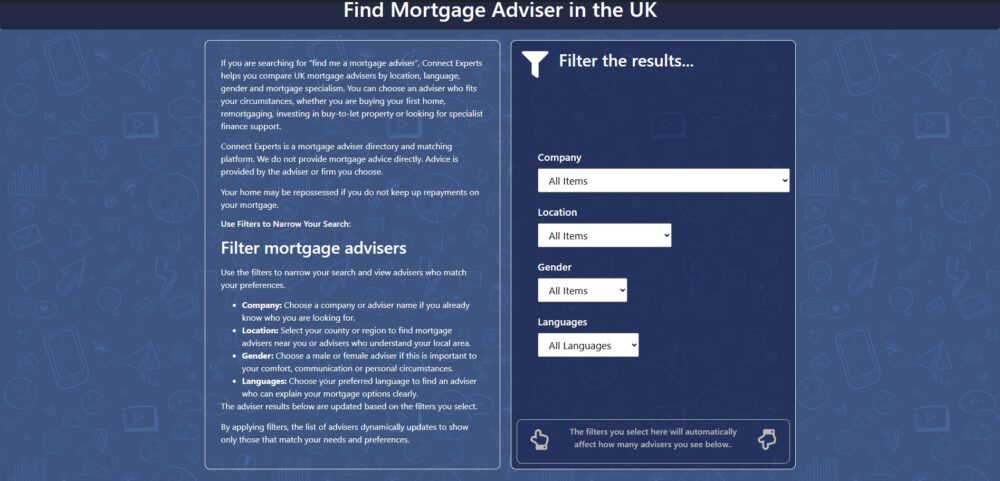
Connect Experts allows you to find a mortgage adviser by location and review advisers according to location, mortgage expertise and other preferences.
Before proceeding, consider asking an adviser:
- Whether they regularly handle your type of mortgage
- Which documents they will need
- How lender affordability will be assessed
- Whether your intended property presents specialist issues
- What fees may be payable
- How they will explain their recommendation
The aim should be to find advice that suits the whole case, not simply an adviser who happens to be closest.
Mortgage Protection and the Longer View
Buying a home creates an asset, but it can also create one of a household’s largest regular financial commitments.
Mortgage planning can therefore include considering what would happen if illness, injury or death affected household income.
A specialist protection broker can discuss areas such as life insurance, critical illness cover and income protection where suitable.
The important question is not simply whether cover exists.
It is whether the amount, term and type of protection reflect the mortgage and the household relying on that income.
Later-Life Mortgage Planning in Lancashire
Lancaster City Council’s housing strategy specifically identifies meeting the needs of older residents as one of its priorities.
For some older homeowners, later-life borrowing may eventually form part of wider financial planning.
That does not mean equity release will be appropriate. It is a long-term financial commitment that requires specialist advice and consideration of alternatives.
Homeowners wanting to explore this separately can find Equity Release Advisers in Lancashire.
Find a Mortgage Adviser in Lancaster
Lancaster’s housing market can involve very different mortgage questions depending on whether you are buying your first flat, moving into a family home, purchasing an older property or financing an HMO.
The right mortgage decision therefore begins with understanding the borrower and the property together.
Connect Experts helps you search advisers by location and specialist experience, compare profiles, and choose who you want to contact.