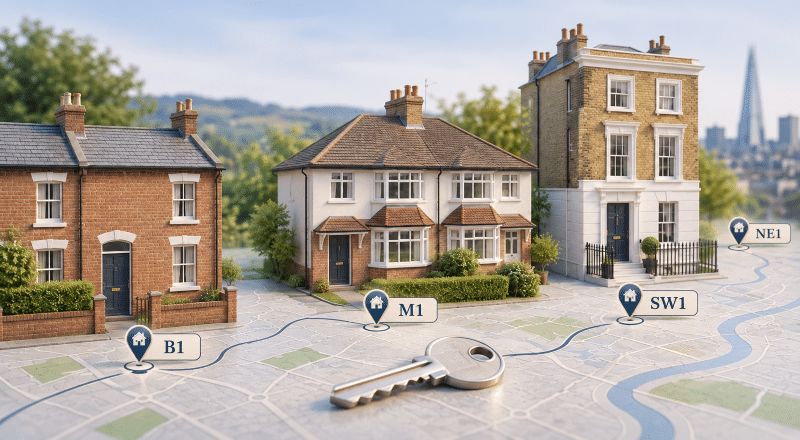
A first-time buyer mortgage is more than a loan; it is a decision shaped by the postcode behind the property.
Every first home begins with an ambition. However, the cost of achieving that ambition changes considerably across England.
For some buyers, the challenge is saving a sufficient deposit. For others, the greater obstacle is proving that their income can support the mortgage.
The latest housing figures reveal why first-time buyers should consider more than the asking price.
At a Glance: What the 2026 Data Tells Us
According to HM Land Registry’s August 2026 House Price Index, the average first-time buyer property price in England was £246,042.
However, the regional figures tell a different story.
| Region | Average first-time buyer property price |
|---|---|
| London | £473,051 |
| South East | £300,015 |
| West Midlands | £213,012 |
| North East | £145,026 |
| England overall | £246,042 |
Source: HM Land Registry, August 2026. Figures are provisional.
The difference between London and the North East exceeds £328,000.
Yet a lower property price does not automatically mean an easier mortgage application.
Household income, existing commitments, credit history and deposit size also influence borrowing decisions.
This is why understanding local property prices is only one part of choosing a suitable mortgage.
Your Deposit Matters, But So Does Your Borrowing Profile
Many people begin their first-time buyer mortgage search by asking how much deposit they need.
The answer depends on the property, lender and mortgage product.
For illustration, a 10% deposit on the average London first-time buyer property would be approximately £47,300.
The equivalent calculation for the North East would be approximately £14,500.
These examples show how location changes the amount buyers may need to save. They do not establish mortgage eligibility.
Lenders also consider your financial position and their own affordability criteria.
Two applicants with the same deposit could receive different borrowing assessments.
For example:
- An employed applicant may receive a regular salary and annual bonus.
- A self-employed applicant may receive dividends or variable profits.
- One buyer may have existing loans or credit commitments.
- Another may receive part of their deposit as a family gift.
These differences can affect which lenders are willing to consider an application.
A first-time buyer mortgage adviser can help you understand how lenders may assess your circumstances.
Mortgage Approvals Are Falling. What Does That Mean for Buyers?
The Bank of England’s September 2026 Money and Credit report, published on 29 October, recorded 53,400 mortgage approvals for house purchases.
That compares with 54,800 approvals in August.
These figures cover house purchases generally, not only first-time buyers.
A decline in approvals does not mean lenders have stopped supporting new buyers.
However, it reinforces the importance of understanding affordability before making a financial commitment.
A mortgage application is not simply about whether you can afford today’s repayment.
Lenders must also consider whether borrowing remains affordable under their assessment criteria.
Therefore, getting an appropriate borrowing assessment before viewing properties can help you set a realistic budget.
Why the Cheapest Mortgage Rate May Not Be the Cheapest Deal
A mortgage with a lower advertised interest rate does not always have the lowest overall cost.
Some products include arrangement fees, valuation costs or other charges.
Others may have restrictions on early repayment or changes to your mortgage.
When comparing products, consider:
- The initial interest rate and monthly repayments.
- The length of the introductory deal.
- Arrangement fees and other mortgage costs.
- The annual percentage rate of charge (APRC).
- Early repayment charges.
- Your deposit and loan-to-value ratio.
- What happens when the initial mortgage deal ends.
You can explore current products using the UK mortgage rates comparison tool.
The comparison should form part of a wider borrowing assessment, not replace individual mortgage advice.
Choosing a Mortgage Adviser Who Understands Your Circumstances
A first-time buyer mortgage adviser should understand both your financial position and the type of property you intend to purchase.
Local experience may be useful where property prices, leasehold arrangements or building types require closer consideration.
For example, someone buying a flat in London may face different property requirements from someone purchasing a house in the West Midlands.
Connect Experts lets you search for advisers by location, mortgage type, language, and other preferences.
You can explore mortgage advisers in London or use the wider UK mortgage adviser directory.
Before contacting an adviser, consider whether they have experience with your income, deposit arrangements and intended property.
You should also confirm their regulatory permissions through the Financial Conduct Authority’s Financial Services Register.
First-Time Buyer Mortgage FAQs
Can I get a first-time buyer mortgage with a 5% deposit?
Some lenders offer mortgages requiring a 5% deposit, subject to their product criteria and affordability assessments.
A smaller deposit usually means a higher loan-to-value ratio, which can affect the available rates and borrowing options.
Does being self-employed make buying my first home more difficult?
Not necessarily. However, lenders may assess income differently.
Some consider business profits, salary, dividends or other evidence of earnings. Requirements vary between lenders.
An adviser experienced with self-employed mortgage applications can explain the documentation lenders may request.
Should I speak to an adviser before finding a property?
Speaking with a mortgage adviser early can help establish your likely borrowing position.
You can then search for properties with a clearer understanding of your deposit, budget and potential monthly costs.
Your First Home Deserves More Than a Mortgage Search
A property price tells you what someone is asking for a home. It does not tell you whether the borrowing is right for you.
The right first-time buyer mortgage decision starts with understanding the numbers behind your circumstances.
Find an adviser who understands your first home plans.
Use Connect Experts to find a mortgage adviser by location and specialism.