Self-Employed and Need a Mortgage? Being self-employed does not prevent you from applying for a mortgage. However, lenders may require additional evidence to verify your income.
The central question is not simply how much your business earns. A lender must decide how much personal income is available, sustainable and suitable for mortgage repayments.
Sole traders, contractors, freelancers, business partners and company directors can therefore be assessed differently.
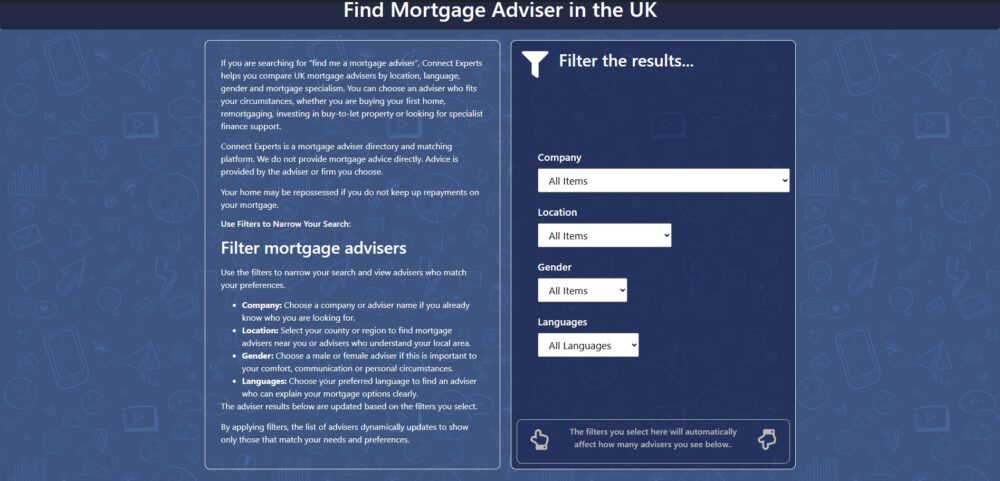
Connect Experts helps you find mortgage advisers who understand self-employed income. You can compare advisers by expertise, location, language and profile before deciding who to contact.
Find a self-employed residential mortgage adviser
Self-Employed and Need a Mortgage?
- Self-employed applicants can apply for residential mortgages.
- Lenders may assess profit, salary, dividends, partnership income or contract earnings.
- Turnover alone does not normally show how much you can borrow.
- You may need accounts, SA302 tax calculations and tax-year overviews.
- Some lenders may consider applicants with one year of trading history.
- Income changes, retained profits and multiple businesses may require closer assessment.
- An adviser can compare lender criteria before an application is submitted.
- Connect Experts helps you find and compare suitable mortgage advisers.
What Does a Mortgage Lender Need to Understand?
A lender needs evidence that your mortgage payments should remain affordable.
For a self-employed applicant, this normally means examining three connected areas:
- Your recorded income
- The stability of your business or work
- Your wider personal financial commitments
A successful business can still produce a complex mortgage application. Turnover, gross profit and cash held by the business do not automatically equal personal income.
The lender must identify the income that can reasonably support your mortgage.
This is why two applicants with similar businesses may receive different affordability results. Their legal structures, drawings, expenses, debts and income histories may differ.
How Is Self-Employed Income Assessed?
There is no single calculation used by every mortgage lender.
The assessment normally depends on how you work and how you receive income.
Sole Traders
A sole trader is commonly assessed using net business profit rather than turnover.
Lenders may review the latest tax calculations, tax-year overviews and business accounts. Some will average income across several years. Others may use the latest year where the result appears sustainable.
A fall in profit may lead to further questions. The lender may ask whether the reduction is temporary, continuing or linked to a specific business expense.
Limited Company Directors
A limited company director may receive:
- PAYE salary
- Dividends
- Pension contributions
- Benefits
- Retained company profit
Some lenders assess salary and dividends. Others may consider a director’s share of company profit or retained profit under certain criteria.
This difference can materially affect affordability. An adviser who understands company-director cases can identify lenders whose methods better reflect the applicant’s income structure.
Applicants with several income streams can also read about complex income mortgages.
Business Partners
A business partner may be assessed using their declared share of the partnership’s profit.
The lender may examine partnership accounts, tax documents, and the applicant’s share of income.
Changes in ownership or profit-sharing arrangements may require additional explanation.
Contractors
Contractors may be assessed through accounts or tax records. Certain lenders may instead use contract income.
The lender could consider:
- Day or hourly rate
- Number of working days
- Current contract length
- Time remaining on the contract
- Previous contracts
- Gaps between contracts
- Experience within the same sector
A future contract does not guarantee acceptance. Its value depends on the lender’s current contractor policy and the wider application.
Freelancers
Freelancers may receive irregular payments from several clients.
A lender may review accounts, tax documents and bank statements to establish whether the income has been consistent.
Regular work from repeat clients can provide useful context. However, future projects are not the same as completed and recorded income.
Which Documents May Be Required?
Requirements differ between lenders. Nevertheless, a self-employed applicant may be asked for:
- SA302 tax calculations
- Tax-year overviews
- Finalised business accounts
- Personal bank statements
- Business bank statements
- Proof of deposit
- Identification and address evidence
- Details of loans, credit cards and other commitments
- Accountant details or an accountant’s certificate
- Current and previous contracts
- Evidence explaining material income changes
- Existing mortgage statements when remortgaging
- Salary and dividend records for company directors
HMRC explains how to obtain an SA302 tax calculation and tax-year overview when proof of earnings is required for a mortgage.
The precise document period will depend on the lender. Preparing documents early can prevent avoidable delays.
Can You Get a Mortgage With One Year of Accounts?
Some lenders may consider applicants with one year of accounts or one completed tax year.
Acceptance is not automatic. The lender may also consider:
- Previous experience in the same occupation
- Income level
- Deposit size
- Credit history
- Business bank activity
- Current contracts
- The strength of the wider application
- Whether the first year appears representative
An applicant who recently moved from employment into the same professional field may be viewed differently from someone entering a new industry.
The quality and continuity of the evidence matter more than a simple label such as “newly self-employed”.
What Happens When Income Has Increased?
Recent growth can support an application, but lenders may treat it cautiously.
Some lenders average several years of income. That calculation can reduce the effect of a stronger recent year.
Another lender may consider the latest result where the increase is supported by:
- Current accounts
- Business bank statements
- Contracts
- Stable demand
- An accountant’s explanation
- Evidence that growth is sustainable
A larger income figure is useful only when the lender accepts the method used to evidence it.
What Happens When Income Has Fallen?
A reduction does not necessarily prevent a mortgage. However, the lender will usually want to understand the cause.
The fall could result from:
- A temporary contract gap
- Parental leave
- Illness
- Business investment
- Loss of a major client
- Economic conditions
- Increased allowable expenses
- A deliberate reduction in working hours
The lender may use the lower figure or request more recent evidence. A clear explanation is important, but it cannot replace evidence of affordability.
Does Tax Planning Affect Mortgage Affordability?
Legitimate tax planning can reduce taxable income. However, a lower declared profit can also reduce the income available for a mortgage assessment.
This creates an important distinction.
A business owner may have strong cash flow while reporting a lower personal income. Yet many lenders base affordability on tax documents, salary and dividends.
Some lenders take a broader view of company profit. Others do not.
Mortgage planning and tax planning should therefore be considered together. Any tax decision should be discussed with a suitably qualified tax professional.
How Much Could a Self-Employed Applicant Borrow?
Borrowing is not determined by employment status alone.
A lender may consider:
- Accepted annual income
- Deposit
- Credit commitments
- Household expenditure
- Dependants
- Mortgage term
- Interest-rate stress testing
- Property type
- Credit history
- Age and expected retirement income
- Other mortgages or investment properties
A simple income multiple cannot provide a reliable answer for every applicant.
The lender must conduct an affordability assessment under its policy and the applicable mortgage rules. An adviser can explain which income figures a lender may use before a full application is made.
How Can You Prepare Before Applying?
Preparation begins with understanding how your income appears on paper.
Check Your Credit Records
Review your records with the main UK credit-reference agencies. Correct any inaccurate personal or account information.
Avoid making several mortgage applications merely to test eligibility. Each lender uses its own criteria, and repeated applications may create unnecessary searches.
Organise Your Accounts and Tax Evidence
Make sure that completed accounts and tax documents are available.
Figures should be consistent across:
- Accounts
- Tax calculations
- Tax-year overviews
- Bank statements
- Application forms
Differences may be explainable, but they should be identified before submission.
Keep Personal and Business Transactions Clear
Separate records make it easier to understand income, expenses and transfers.
Unexplained cash movements, large deposits or regular overdraft use may lead to further questions.
Explain Changes Before They Become Problems
Tell the adviser about changes in:
- Business structure
- Ownership
- Income
- Contracts
- Working patterns
- Accountants
- Trading activity
- Personal borrowing
An adviser can only assess the case accurately when the relevant facts are available.
Review Your Deposit
The deposit must be evidenced.
Savings, gifts, equity and business funds can be treated differently. Using money from a limited company may also create tax and accounting considerations.
Your mortgage adviser, accountant and solicitor may each need to review different parts of the transaction.
When May a Specialist Mortgage Adviser Help?
Specialist support may be useful when:
- You have one year of accounts
- Your latest income has increased
- Your income has recently fallen
- You use salary and dividends
- Your company retains profit
- You work through several companies
- You have contract-based income
- You have more than one occupation
- You combine employment and self-employment
- You are self-employed with adverse credit
- You own investment properties
- You need to remortgage after becoming self-employed
- Your accountant has recently changed your business structure
The adviser’s role is not to make an unsuitable application appear stronger. It is to establish the facts, compare relevant lender policies and present accurate evidence.
How to Find a Self-Employed Mortgage Adviser
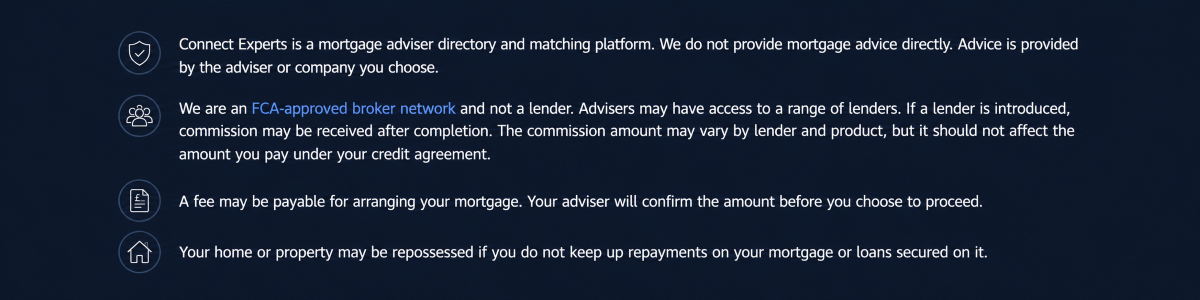
Connect Experts is a mortgage adviser directory and matching platform.
It does not provide mortgage advice directly. Advice is provided by the adviser or firm you select.
You can use the directory to review practical details before making contact.
Step 1: Select the Relevant Expertise
Choose an adviser who handles residential mortgages for self-employed applicants.
Your search may need to reflect further circumstances, such as contractor income, adverse credit or several businesses.
Step 2: Review Adviser Profiles
Profiles may include:
- Adviser location
- Mortgage specialisms
- Languages spoken
- Gender
- Firm information
- Contact details
- Areas served
These details can help you create a shortlist based on your requirements.
Step 3: Discuss Your Income Structure
Explain how you trade and receive income.
Mention any recent changes before the adviser begins researching lenders.
Step 4: Ask What Evidence Is Needed
The adviser should explain which documents are likely to be required and whether further information may strengthen the assessment.
Step 5: Understand Fees and Service
Ask how the adviser is paid, whether a fee applies and when it becomes payable.
The adviser should explain these points before you decide to proceed.
Search the Connect Experts mortgage adviser directory
Questions to Ask a Mortgage Adviser
Before choosing an adviser, consider asking:
- Do you regularly handle self-employed mortgage applications?
- Which income figure is likely to be used in my circumstances?
- Have you reviewed cases involving my business structure?
- Could any lender consider retained company profit?
- How might a recent income change affect the application?
- What documents should I prepare?
- Will you check lender criteria before submitting an application?
- Which lenders can you access?
- What fees may apply?
- Who will manage the case after submission?
The most suitable adviser is not necessarily the nearest one. Relevant experience, communication and access to suitable lender criteria may be more important.
Frequently Asked Questions
Can a self-employed person get a mortgage?
Yes. Self-employed people can apply for mortgages. Lenders normally require evidence showing the amount, history and sustainability of income.
Is a self-employed mortgage a separate product?
Usually, no. Applicants generally apply for standard mortgage products. The difference concerns how income and affordability are assessed.
How long must I have been self-employed?
Many lenders prefer at least two years of accounts or tax records. Some may consider one year, subject to their criteria and the strength of the application.
Do lenders use turnover or profit?
Sole traders are commonly assessed using net profit rather than turnover. Company directors may be assessed using salary, dividends or another accepted measure of company profit.
Can retained profit be used?
Some lenders may consider retained profit for limited company directors. Others assess only salary and dividends. Eligibility depends on ownership, accounts and lender policy.
Can I get a mortgage after changing from employed to self-employed?
Possibly. Relevant experience, trading history, contracts, income evidence and deposit may all affect the decision.
Are SA302 documents always required?
Not in every case. However, many lenders request tax calculations and tax-year overviews to verify self-employed income.
Can I remortgage after becoming self-employed?
Yes, subject to affordability and lender criteria. The income evidence required may differ from the evidence used for the original mortgage. You can compare remortgage mortgage brokers through Connect Experts.
Does a large deposit guarantee approval?
No. A larger deposit may improve the available options, but lenders must still assess income, affordability, credit history and the property.
Does Connect Experts provide mortgage advice?
No. Connect Experts helps users find and compare mortgage advisers. Mortgage advice is provided by the adviser or authorised firm selected by the user.
Find an Adviser Who Understands Self-Employed Income
Self-employment changes the evidence used in a mortgage application. It does not remove the need for a clear affordability assessment.
The strongest application is not always the one with the highest turnover. It is the one whose income, commitments and supporting evidence can be understood consistently.
Connect Experts can help you find an adviser who works with sole traders, freelancers, contractors, business partners and company directors.
Compare self-employed mortgage brokers