How 100% Mortgages Work for First-Time Buyers: A 100% mortgage may allow an eligible buyer to borrow the entire purchase price.
These products remain subject to affordability, credit, property and lender criteria. They may also carry greater negative-equity risk than lower-LTV borrowing.
Compare the structure with 95% and family-assisted options before applying.
What Is a 100% Mortgage?
A 100% mortgage has a loan-to-value ratio of 100%.
For example:
- Property price: £250,000
- Buyer’s cash deposit: £0
- Mortgage required: £250,000
- Loan-to-value: 100%
This does not mean the purchase has no upfront costs.
The buyer may still need money for:
- Legal fees
- Searches
- Surveys
- Mortgage fees
- Moving costs
- Insurance
- Initial repairs
- Leasehold charges, where applicable
A no-deposit mortgage removes the purchase deposit. It does not remove every cost.
Who May Qualify?
Criteria differ between lenders and products.
A lender may examine:
- Stable income
- Employment history
- Credit conduct
- Rental-payment history
- Existing commitments
- Disposable income
- Applicant age
- Property type
- Purchase price
- Expected term
Some products are designed around a record of rent payments. Others require family security or savings.
The Connect Experts 100% Mortgage Guide explains that some products may not require family support, while others use family savings or guarantees.
Why Is Affordability Still Important?
The absence of a deposit does not increase the amount a buyer can automatically borrow.
The lender still calculates whether the payments appear affordable.
Suppose a buyer can borrow £220,000 based on income and expenditure. A 100% product does not necessarily allow them to buy a £250,000 property.
Loan-to-value and affordability answer different questions:
- LTV: How much of the property price is borrowed?
- Affordability: Can the applicant support the proposed loan?
Both must satisfy the lender.
What Is Negative Equity?
Negative equity occurs when the mortgage balance exceeds the property’s value.
For example:
- Purchase price: £250,000
- Mortgage: £250,000
- Later property value: £235,000
- Approximate negative equity: £15,000
This can restrict the ability to sell or remortgage.
A repayment mortgage gradually reduces the balance. However, property values can move in either direction.
The risk deserves particular attention when a buyer expects to move again within a short period.
Are 100% Mortgage Rates Higher?
They can be higher than rates available at lower LTV levels.
A lender has no deposit cushion if the property must be sold following repossession. That additional risk can affect:
- Interest rate
- Product fee
- Credit requirements
- Property restrictions
- Affordability assessment
The lowest initial cash requirement is not automatically the lowest long-term cost.
100% Versus 95% Mortgages
A 95% mortgage requires a 5% deposit.
On a £250,000 property, that is £12,500.
Compared with 100% lending, a 95% mortgage may provide:
- More lender choice
- Lower pricing in some cases
- Immediate owner equity
- Reduced negative-equity exposure
However, saving the deposit may delay the purchase.
The comparison should include rent paid while saving, product cost, monthly payments and financial resilience.
Can Family Support Help?
Some mortgage structures use family savings or property as additional security.
The family member may not need to give the buyer the money permanently. However, their funds can be restricted for a defined period.
Each person should understand:
- When the security can be released
- Whether interest is paid
- What happens after missed mortgage payments
- Whether the arrangement affects future plans
- Whether independent legal advice is required
How Can an Adviser Be Found?
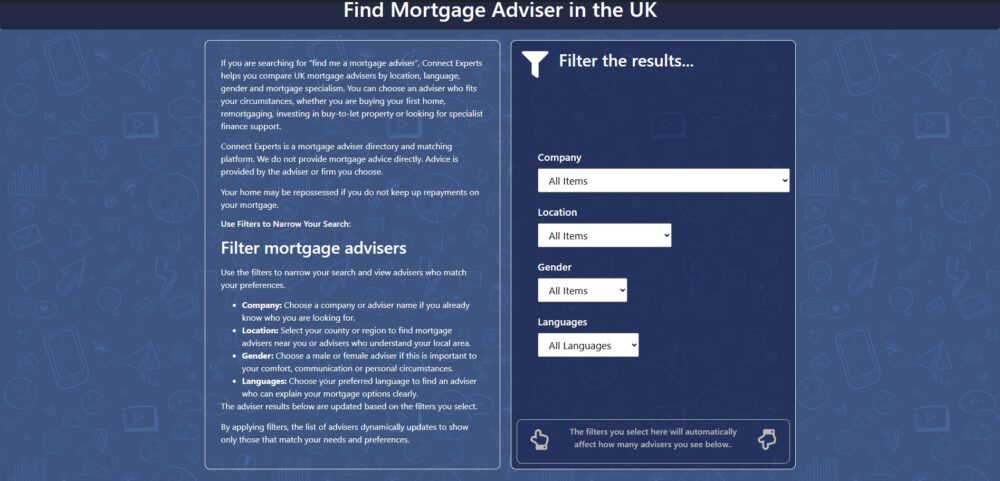
Connect Experts allows users to compare advisers for first-time buyers by location, language and mortgage experience.
Ask the adviser to compare:
- 100% borrowing
- 95% borrowing
- Gifted deposits
- Family-assisted products
- Shared ownership
- Delaying the purchase to save more
The purpose of advice is not to prove that buying now is possible. It is to test whether the structure remains workable after completion.
How Can Connect Experts Help?
Connect Experts does not provide mortgage advice directly. It helps users compare adviser profiles.
You can search by location, language and relevant mortgage experience through the mortgage adviser directory.