Finding a mortgage broker in Edinburgh is not simply a search for the lowest advertised rate. It is a search for an adviser who understands your income, deposit, property plans and the distinct Scottish home-buying process.
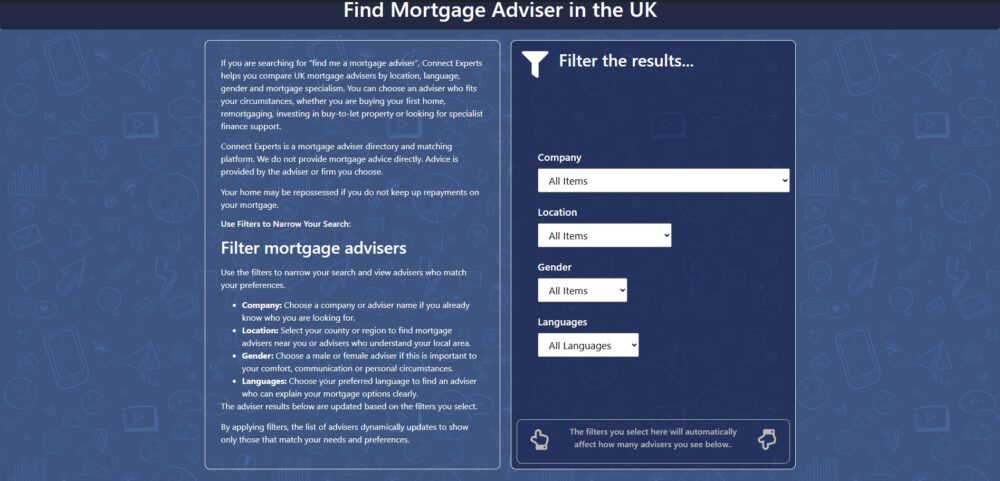
Connect Experts helps you compare mortgage advisers by location, expertise, language and personal preference. You can review adviser profiles and choose someone whose experience matches your circumstances.
Whether you are buying in EH1, moving to EH10, remortgaging in EH4 or considering an investment property in Leith, the aim is the same: find qualified guidance before making a significant financial commitment.
Find mortgage advisers through the Connect Experts directory.
Finding a Mortgage Broker in Edinburgh
An Edinburgh mortgage broker can review your borrowing position, explain lender criteria and help you prepare a mortgage application.
Through Connect Experts, you can search for advisers who support:
- First-time buyers.
- Home movers.
- Remortgage clients.
- Self-employed applicants.
- Landlords and property investors.
- Buyers with adverse credit.
- High-value and complex-income borrowers.
- Applicants needing specialist property finance.
Connect Experts is a directory and matching platform. It does not provide individual mortgage advice directly. The adviser or firm you choose will assess your needs and provide any recommendation.
Edinburgh Mortgage Market Snapshot
Edinburgh is one of Scotland’s largest and highest-value residential property markets.
According to current official housing data:
- The average Edinburgh house price was approximately £296,000 in May 2026.
- This represented annual growth of 2.4%.
- Edinburgh recorded 11,169 residential sales during 2025 to 2026.
- The city was one of Scotland’s two largest local authority markets by transaction volume.
These figures describe the whole City of Edinburgh local authority area. Individual streets, property types and EH postcodes may perform very differently.
A traditional tenement flat in Marchmont will not necessarily be valued or assessed in the same way as a detached home in Barnton, a new-build apartment in Leith or a Georgian property in the New Town.
This variation is one reason local and property-specific mortgage knowledge can be valuable.
What Does an Edinburgh Mortgage Broker Do?
An Edinburgh mortgage broker assesses your circumstances and helps identify mortgage options that may suit your needs.
The work can include:
- Reviewing income, expenditure and existing commitments.
- Estimating a realistic borrowing range.
- Explaining deposit and loan-to-value requirements.
- Comparing suitable lenders and mortgage products.
- Checking how lenders may assess the chosen property.
- Preparing documents for underwriting.
- Submitting and managing the mortgage application.
- Communicating with lenders, valuers, solicitors and estate agents.
- Explaining fees, product charges and early repayment terms.
- Discussing relevant protection needs.
A broker cannot guarantee that a lender will approve an application. The final decision remains with the lender and depends on affordability, credit history, property acceptability and the lender’s criteria.
How Connect Experts Helps You Find an Adviser
A general internet search can produce hundreds of results, many of which may not be relevant to your situation.
Connect Experts provides a more focused route. Its directory allows you to search and compare advisers using practical criteria.
Search by location
You can look for advisers who support clients in Edinburgh or the wider Scottish market.
A local address is not the only sign of suitability. Many advisers work remotely across the UK. The essential question is whether the adviser understands your mortgage type and the Scottish purchasing process.
Search by mortgage expertise
Different applications need different knowledge.
A first-time buyer may need help with affordability and closing dates. A landlord may need rental stress testing. A company director may need an adviser who understands retained profit, salary and dividends.
You can find a broker by mortgage expertise rather than relying on a broad location search alone.
Search by language
Mortgage terminology can be difficult, especially when English is not your preferred language.
The directory can help you identify advisers who speak additional languages and may be able to explain complex information more clearly.
Search by personal preference
Some clients prefer an adviser of a particular gender or someone with experience supporting a specific type of borrower.
A preference does not replace professional competence, but comfortable communication can improve the quality of the discussion.
Why Edinburgh Mortgage Advice Can Require Local Knowledge
The mortgage itself is governed by lender criteria and UK regulation, but buying a property in Scotland follows a different process from buying in England or Wales.
An adviser supporting an Edinburgh purchase should understand how the following issues can affect timing, deposit planning and the mortgage application.
Home Reports
Most homes marketed for sale in Scotland require a Home Report.
A Home Report usually contains:
- A Single Survey.
- An Energy Report.
- A Property Questionnaire.
The Single Survey includes a valuation. A lender may use that figure when determining the maximum mortgage, although it can still request its own valuation.
This becomes important when a buyer offers more than the Home Report valuation. A lender will not automatically lend against the full offer price.
Offers over
Many Edinburgh properties are marketed using an “offers over” price.
The amount accepted by the seller may be higher than:
- The asking price.
- The Home Report valuation.
- The amount on which the lender bases its loan-to-value calculation.
The difference may need to come from the buyer’s own funds.
For example, a property could have a Home Report valuation of £300,000 but attract an accepted offer of £320,000. A lender assessing the mortgage against £300,000 may require the buyer to fund the £20,000 difference as well as the normal deposit and purchasing costs.
This is why an early review of accessible funds is critical.
Closing dates
Where several buyers express interest, the seller may set a closing date.
Prospective buyers normally submit their best offer through a solicitor by a stated deadline. The seller is not required to accept the highest offer.
Having an Agreement in Principle can help demonstrate preparation, but it is not a mortgage offer and does not guarantee approval for a mortgage.
Missives
In Scotland, the contractual correspondence between the buyer’s and seller’s solicitors is known as missives.
Once missives are concluded, the agreement is legally binding. Buyers should not assume they can withdraw without financial or legal consequences.
Your mortgage adviser and solicitor perform different roles. The adviser deals with borrowing and lender requirements. The solicitor handles the legal transaction.
Land and Buildings Transaction Tax
Land and Buildings Transaction Tax, known as LBTT, applies to qualifying property transactions in Scotland.
The amount depends on factors including:
- Purchase price.
- Whether the property will be your main residence.
- Whether you qualify for first-time buyer relief.
- Whether you already own another residential property.
- Whether the Additional Dwelling Supplement applies.
Current bands and rules should always be checked through Revenue Scotland’s LBTT guidance.
A mortgage adviser may help you account for tax within your available funds, but formal tax advice should come from a qualified tax professional.
Mortgage Advice for Edinburgh First-Time Buyers
A first-time buyer mortgage adviser can help you understand what may be affordable before you begin making offers.
The process may include reviewing:
- Your deposit.
- Income and employment.
- Credit commitments.
- Monthly expenditure.
- Student loans.
- Childcare or maintenance payments.
- Likely mortgage term.
- Product fees.
- Home Report valuation.
- Funds needed above valuation.
- LBTT and legal expenses.
The emotional pressure of a closing date can encourage buyers to offer quickly. However, speed should not replace financial discipline.
A home is both a place to live and a long-term obligation. The strongest offer is not always the highest one. It is the offer that remains affordable after the excitement has passed.
For specialist support, compare first-time buyer mortgage brokers.
Remortgaging an Edinburgh Property
Remortgaging means moving your mortgage to a new arrangement, usually with a different lender. A product transfer normally means selecting a new deal with your existing lender.
An adviser can compare both routes where appropriate.
A review may consider:
- The remaining mortgage balance.
- Current property value.
- Loan-to-value.
- Existing early repayment charges.
- Product fees.
- Monthly payments.
- Mortgage term.
- Plans to move.
- Additional borrowing.
- Income or credit changes.
- Whether the property will remain your main residence.
Starting early can give you more time to compare options. It may also reduce the risk of moving onto a lender’s reversion rate without reviewing alternatives.
Search for remortgage mortgage brokers with experience relevant to your circumstances.
Self-Employed Mortgage Applicants in Edinburgh
Being self-employed does not automatically prevent you from obtaining a mortgage.
The challenge is often proving sustainable income in a format that meets lender criteria.
Lenders may assess:
- Sole trader net profit.
- Partnership income.
- Limited company salary and dividends.
- Retained company profit.
- Contractor day rates.
- Recent trading history.
- Business stability.
- Tax calculations and tax-year overviews.
- Company accounts.
- Bank statements.
- Existing business commitments.
Different lenders may interpret the same income differently. One may use salary and dividends, while another may take a broader view of the company’s profits.
A self-employed mortgage broker can help you understand how your income may be presented before an application is submitted.
Buy-to-Let Mortgages in Edinburgh
Edinburgh has rental demand from students, professionals, families and people relocating for employment. However, demand alone does not make every property a suitable investment.
Buy-to-let lenders may consider:
- Expected monthly rent.
- Rental coverage.
- Stress-test calculations.
- Deposit.
- Property value.
- Property type.
- Landlord experience.
- Personal income.
- Credit history.
- Ownership structure.
- Existing property portfolio.
Scottish landlords must also consider registration, tenancy obligations and property standards.
For additional properties, the Additional Dwelling Supplement may apply. The current rate and rules can materially affect the amount of cash required at completion.
Prospective landlords can compare buy-to-let mortgage brokers with relevant experience in investment property.
Some forms of buy-to-let borrowing are not regulated by the Financial Conduct Authority.
HMO and Student Property Finance
Edinburgh’s universities support demand for shared accommodation, but an HMO is not simply a larger buy-to-let property.
Mortgage lenders may examine:
- Number of lettable rooms.
- Number of households.
- Licence requirements.
- Property layout.
- Fire and safety provisions.
- Planning position.
- Valuation method.
- Landlord experience.
- Management arrangements.
- Expected rental income.
Lender definitions and local authority definitions do not always operate in exactly the same way. A property could require specialist finance even when the owner’s understanding of its use differs.
Use the directory to compare HMO mortgage brokers before committing to a purchase or conversion.
High-Value Mortgages in Edinburgh
Edinburgh contains some of Scotland’s most valuable residential districts, including parts of the New Town, West End, Stockbridge, Grange, Morningside, Murrayfield, Barnton and Trinity.
High-value cases can involve more than a large salary.
Borrowers may have:
- Bonuses.
- Dividends.
- Retained company profits.
- Partnership drawings.
- Investment income.
- Trust income.
- Overseas income.
- Several properties.
- Significant assets but irregular cash flow.
- Private banking relationships.
- Complex ownership arrangements.
A standard affordability model may not reflect the borrower’s complete financial strength.
Where the purchase, loan, or wealth structure is complex, compare high-net-worth mortgage brokers who understand large loans and non-standard income.
An adviser may coordinate the mortgage application, but independent tax, legal and investment advice may also be required.
Property Types Edinburgh Lenders May Assess Differently
Edinburgh has varied housing stock. Property design, construction and condition can influence lender acceptance.
Traditional tenement flats
Lenders and valuers may consider:
- Building condition.
- Roof and common repairs.
- Factoring arrangements.
- Shared maintenance liabilities.
- Alterations.
- Floor level.
- Access.
- Marketability.
Buyers should examine the Home Report and ask their solicitor about common repair responsibilities.
Georgian and listed buildings
Older or listed homes may have specialist maintenance requirements.
The lender may consider construction, condition, insurance and resale demand. Significant defects can lead to retention conditions, further reports or reduced lending.
New-build flats
New-build criteria can include:
- Maximum loan-to-value.
- Incentives from the developer.
- Warranty provider.
- Ground-floor commercial use.
- Concentration of investor ownership.
- Expected resale market.
- Remaining development work.
Ex-local authority properties
Lenders may review construction, location, building height, access and the proportion of privately owned units.
Criteria differ considerably, so the property should be discussed before a lender is selected.
Properties above commercial premises
A flat above a restaurant, bar, takeaway, or late-opening business may attract fewer lenders due to noise, smell, access, or resale concerns.
Short-term lets
Short-term letting in Scotland is subject to a mandatory licensing system.
Property use, planning, lender consent, insurance and local licensing requirements should be checked before purchase. A normal residential or standard buy-to-let mortgage may not permit short-term letting.
Choosing the Right Edinburgh Mortgage Adviser
The right adviser is not necessarily the closest adviser or the person offering the fastest initial response.
Ask practical questions.
Are you authorised to provide the service I need?
Check the firm and its permissions using the FCA Firm Checker.
The FCA states that its checker can help consumers confirm whether a firm is authorised and has permission to provide the relevant service.
What type of cases do you normally handle?
Ask whether the adviser regularly supports applicants with circumstances similar to yours.
Examples include:
- First-time buyers.
- Contractors.
- Company directors.
- Portfolio landlords.
- Adverse credit.
- High-value borrowing.
- Overseas income.
- Unusual properties.
Which lenders can you consider?
Some advisers review a broad range of lenders. Others work with a restricted panel.
Ask the adviser to explain the scope of their service clearly.
How are you paid?
Ask about:
- Broker fees.
- When fees become payable.
- Whether any fee is refundable.
- Lender commission.
- Valuation charges.
- Product fees.
- Legal costs.
A low rate can still produce a higher total cost when fees are included.
Who will manage the application?
Find out whether you will deal with the same adviser throughout the process or whether the case will pass to an administrator.
Both approaches can work, but responsibilities should be clear.
How will you communicate?
Agree how often you will receive updates and whether communication will take place by telephone, email, video call or secure portal.
Clear communication provides reassurance when deadlines are tight.
Edinburgh Mortgage Readiness Checklist
Prepare the following before speaking with an adviser.
Identity and address
- Passport or driving licence.
- Recent proof of address.
- Address history.
- Immigration or residency evidence where relevant.
Income
- Recent payslips.
- Latest P60.
- Employment contract.
- Bonus or commission records.
- Tax calculations.
- Tax-year overviews.
- Company accounts.
- Business and personal bank statements.
- Contractor agreements.
Deposit
- Savings statements.
- Evidence of investment withdrawals.
- Gifted-deposit letter.
- Evidence of inheritance.
- Sale proceeds.
- Explanation of any recent large credits.
Credit and commitments
- Loan balances.
- Credit-card balances.
- Car-finance details.
- Student-loan deductions.
- Maintenance commitments.
- Existing mortgage statements.
- Details of adverse credit.
Property
- Sales particulars.
- Home Report.
- Purchase price.
- Home Report valuation.
- Property address.
- Expected rental income where applicable.
- Details of incentives for a new build.
- Information about planned alterations.
Complete information allows the adviser to give a more accurate initial assessment.
Areas Covered Across Edinburgh
Mortgage advisers found through Connect Experts may support clients throughout Edinburgh and nearby EH postcode districts, including:
- Edinburgh city centre.
- Old Town.
- New Town.
- Stockbridge.
- Leith.
- Newhaven.
- Trinity.
- Morningside.
- Bruntsfield.
- Marchmont.
- Newington.
- Portobello.
- Corstorphine.
- Murrayfield.
- Barnton.
- Cramond.
- Colinton.
- Liberton.
- South Gyle.
- Craiglockhart.
- Balerno.
- Currie.
- Musselburgh and surrounding commuter areas.
The adviser does not necessarily need to be physically based in the same postcode. Relevant experience, regulatory status, lender access and communication quality are usually more important than distance alone.
Frequently Asked Questions
How do I find a mortgage broker in Edinburgh?
Use the Connect Experts directory to compare mortgage advisers by location, expertise, language and personal preference. Review individual profiles and ask each adviser about qualifications, regulatory status, fees, lender access and experience with your mortgage type.
Is a mortgage broker the same as a mortgage adviser?
The terms are often used interchangeably in the UK. Both may describe a professional who assesses your circumstances, explains mortgage options and recommends a suitable product where authorised to do so.
Should I speak to an adviser before viewing properties in Edinburgh?
It can be useful. An adviser can provide an initial view of affordability, deposit requirements and likely monthly payments. This may help you search within a realistic range, although any initial estimate is not a mortgage guarantee.
Do I need an Agreement in Principle?
An Agreement in Principle is not always legally required, but sellers and estate agents may ask for evidence that you have considered your finance. It is not a formal mortgage offer and can still be subject to underwriting and valuation.
Can I borrow above the Home Report valuation?
A lender normally bases its calculation on the lower of the purchase price or accepted valuation. Where an offer exceeds the Home Report valuation, the buyer may need to fund the difference from personal resources.
Can a broker guarantee my Edinburgh mortgage?
No. A broker can assess your circumstances and recommend a suitable route, but the lender makes the final decision.
Can an Edinburgh adviser help if I have adverse credit?
Some advisers specialise in cases involving missed payments, defaults, county court judgments or other credit problems. Options depend on the type, value, age and circumstances of the credit event.
Can I use an adviser who is not based in Edinburgh?
Yes. Many mortgage applications are managed remotely. The adviser should understand the relevant Scottish process and have experience with your type of application.
How much does a mortgage broker charge?
Fees vary. Some advisers charge a fixed fee, a percentage or staged fees. Others may receive lender commission. Ask for a clear written explanation before agreeing to proceed.
Does Connect Experts provide mortgage advice?
No. Connect Experts helps users search for mortgage advisers. Advice is provided by the adviser or firm selected by the user.
Find a Mortgage Broker in Edinburgh
A mortgage is a technical contract, but it also shapes everyday life. It influences where you live, how much financial flexibility you retain and how confidently you can respond to future change.
Good advice does not remove uncertainty. It turns uncertainty into questions that can be measured, checked and understood.
Use Connect Experts to compare advisers by location, expertise, language, and preferences, then speak with someone whose experience aligns with your goals.
Search the Connect Experts mortgage adviser directory.