Finding a Mortgage Broker in Route should be about more than choosing the nearest adviser. A mortgage decision connects your income, deposit, property, credit profile and future plans with lender criteria that can change over time.
For buyers in Cambridgeshire, property values and housing types can also differ substantially between Cambridge, market towns, villages and more rural areas.
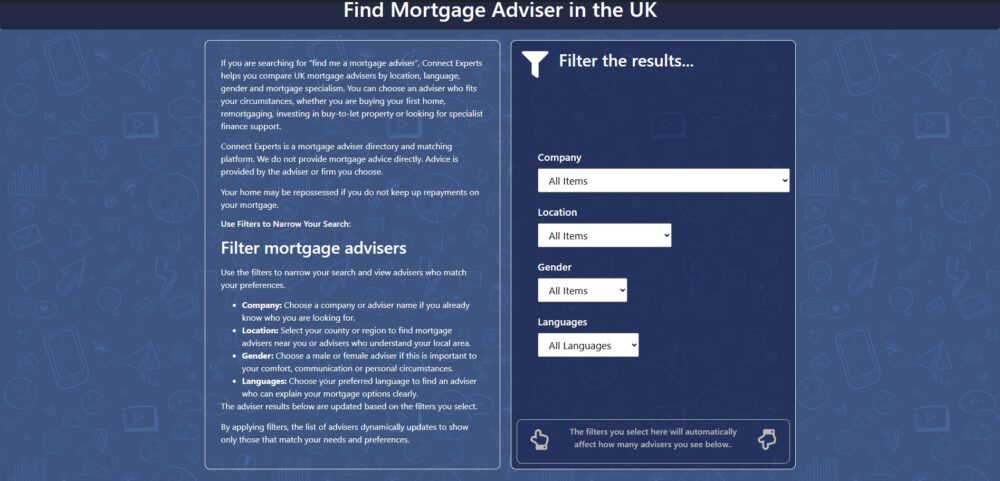
Connect Experts helps you find mortgage advisers by location and compare advisers based on the expertise, language, and type of support you need.
Connect Experts is a mortgage adviser directory and matching platform. It does not provide mortgage advice directly. Advice is provided by the adviser or firm you choose.
Finding Mortgage Advice in Route
- Compare advisers according to your mortgage requirements, rather than choosing by distance alone.
- Your income, deposit, credit commitments and property can affect lender affordability.
- Cambridgeshire’s average house price was £336,451 in June 2026, according to the UK House Price Index.
- Property values vary considerably across the county, so local context matters.
- Buyers may need specialist help for self-employed income, buy-to-let, unusual property or more complex circumstances.
- Connect Experts lets you search advisers by location, mortgage expertise and language.
- Always check a firm’s regulatory status and permissions before proceeding.
The Cambridgeshire Property Market in 2026
Mortgage decisions begin with people, but they are secured against property. That makes the local housing market an important part of the conversation.
According to the UK House Price Index for June 2026, the average property price in Cambridgeshire was £336,451, compared with £326,486 a year earlier. That represented annual growth of approximately 3.1%.
The figures also demonstrate why county-wide averages should be treated as context rather than a valuation of an individual home.
Cambridge, for example, recorded an average property price of £471,098 in the same government data.
A property buyer therefore needs to consider more than the headline county average.
Factors may include:
- the agreed purchase price;
- property type;
- available deposit;
- loan-to-value;
- expected lender valuation;
- monthly affordability;
- existing borrowing;
- income structure;
- and the property’s suitability as mortgage security.
A Mortgage Broker in Route can assess your circumstances before you submit an application and explain which factors may affect the lenders available to you.
Why Property Type Can Matter to a Mortgage
A mortgage lender does not assess the borrower in isolation.
It also considers the property being purchased or remortgaged.
Mainstream houses can often present a relatively straightforward security assessment. However, some Cambridgeshire properties may require closer consideration.
Examples can include:
- older homes;
- period properties;
- listed buildings;
- converted properties;
- leasehold flats;
- properties above commercial premises;
- rural homes;
- homes with substantial land;
- unusual construction;
- new-build homes;
- and properties requiring significant work.
The issue is not whether a property is desirable. The question for a lender is whether it meets its lending and valuation criteria.
This is one reason specialist mortgage knowledge can matter.
How Mortgage Affordability Is Assessed
A lender does not normally decide how much you can borrow by simply multiplying your salary by a fixed figure.
Modern mortgage affordability assessments usually consider several elements together.
These can include:
- basic salary;
- regular overtime;
- bonuses;
- commission;
- self-employed profits or salary and dividends;
- pension income;
- rental income where applicable;
- existing loans;
- credit cards;
- childcare commitments;
- dependants;
- mortgage term;
- interest-rate stress testing;
- and monthly household expenditure.
Different lenders can assess the same applicant differently.
One lender may accept a larger proportion of variable income, while another may require a longer history.
A mortgage adviser can therefore help establish how your evidence fits different lending policies before recommending an appropriate route.
Self-Employed Mortgage Applicants in Cambridgeshire
Self-employment does not automatically prevent someone from obtaining a mortgage.
However, evidence can become particularly important.
Depending on the lender and business structure, applicants may be asked for information such as:
- finalised accounts;
- SA302 calculations;
- tax year overviews;
- salary and dividend details;
- retained profit information;
- business bank statements;
- current contracts;
- or accountant information.
A sole trader, company director and contractor may therefore be assessed in different ways.
The relevant question is not simply, “How much do you earn?”
It is often:
How does a particular lender calculate the income available for mortgage affordability?
Finding an adviser with experience in complex income can be useful when income doesn’t fit a conventional monthly salary structure.
First-Time Buyers in Route
Buying a first home is often where mortgage terminology becomes real.
Loan-to-value, affordability, product fees, valuations and mortgage terms can quickly turn an apparently simple rate comparison into a larger financial decision.
A first-time buyer will usually need to establish:
- the deposit available;
- the approximate property budget;
- likely borrowing capacity;
- monthly repayments;
- purchase costs;
- lender eligibility;
- and the documents needed for an application.
Having a larger deposit can reduce loan-to-value, although it does not guarantee mortgage approval or a particular interest rate.
A mortgage adviser can explain how the available deposit interacts with affordability and lender criteria.
Moving Home in Cambridgeshire
Moving property may involve selling one home while buying another.
That can mean managing an existing mortgage while applying for new borrowing.
Questions may include:
- Can the existing mortgage be transferred?
- Is the current mortgage portable?
- Would an early repayment charge apply?
- Is additional borrowing required?
- Has income changed since the existing mortgage began?
- Will the new property meet the lender’s criteria?
- Would changing lender offer a more suitable outcome?
Portability does not automatically mean that an existing mortgage can simply be transferred.
The lender will normally reassess affordability and the new property.
Remortgaging in Route
A remortgage can involve moving an existing mortgage to another lender.
Homeowners may consider remortgaging when:
- an initial mortgage deal is approaching its end;
- circumstances have changed;
- they want to review monthly costs;
- they require additional borrowing;
- the property value has changed;
- or their longer-term plans have developed.
However, switching mortgages does not always produce a better financial result.
Potential costs can include:
- early repayment charges;
- arrangement fees;
- valuation costs;
- legal costs;
- and changes in interest rate.
Borrowers should compare the total cost rather than focusing only on the advertised rate.
Connect Experts also has a dedicated residential adviser search for mortgage rates ending if an existing deal is approaching expiry.
Buy-to-Let Property in Cambridgeshire
Cambridgeshire contains several different rental markets.
Rental demand can be influenced by local employment, universities, commuting patterns, housing supply and the type of property being offered.
Buy-to-let affordability is also assessed differently from a standard residential mortgage.
Depending on the lender, factors can include:
- expected monthly rent;
- interest coverage calculations;
- borrower tax status;
- personal or limited company ownership;
- portfolio size;
- property type;
- loan-to-value;
- and previous landlord experience.
Some buy-to-let mortgages are not regulated in the same way as residential mortgages.
An adviser should explain whether a proposed mortgage falls inside or outside FCA regulation before you proceed.
Independent Schools and Education Finance
Cambridgeshire has a significant independent education sector.
The Independent Schools Council lists schools across locations including Cambridge, Ely, Girton, Huntingdon, Papworth Everard, Peterborough and Wisbech.
For some families, buying a property can therefore form part of a wider decision involving school location, commuting and education costs.
Private school fees can also influence household affordability.
Families with significant property equity or other assets may sometimes want to consider how education costs fit alongside their broader borrowing arrangements.
Connect Mortgages provides further information about Educational Finance.
Using property to raise money carries risks and should be considered carefully alongside other financial options.
Later-Life Property Decisions
Property plans can also change as people approach or enter retirement.
Some homeowners may decide to:
- move to a smaller property;
- relocate;
- repay an existing mortgage;
- help family members financially;
- adapt their current home;
- or consider releasing property wealth.
These are different financial decisions and should not automatically be treated as conventional remortgaging.
People exploring later-life borrowing can read more through Equity Release Advisers in Cambridgeshire.
Equity release will reduce the value of your estate and may affect entitlement to means-tested benefits. It is not suitable for everyone.
Do You Need a Mortgage Adviser Based in Route?
Not necessarily.
Local knowledge can be useful, especially where property characteristics or valuations need further discussion.
However, the adviser’s relevant mortgage expertise may be more important than their office postcode.
Telephone and video appointments allow many mortgage advisers to support borrowers outside their immediate area.
Connect Experts enables borrowers to search the UK mortgage adviser directory and compare advisers using several criteria.
These include:
- location;
- mortgage requirement;
- language;
- gender;
- adviser profile;
- and relevant areas of expertise.
This gives clients greater freedom to look beyond the nearest available adviser.
Finding Mortgage Advice in Your Preferred Language
Mortgage conversations can include unfamiliar technical terms.
Understanding income calculations, mortgage conditions, fees and lender requirements is important before agreeing to proceed.
Connect Experts allows people to find a mortgage adviser by language.
The directory includes advisers who state that they can communicate in languages including Mandarin, Romanian, Turkish and many others.
Language should not be the only factor when choosing an adviser.
You should also check:
- relevant mortgage expertise;
- regulatory status;
- available lenders;
- fees;
- adviser permissions;
- and whether the adviser regularly handles circumstances similar to yours.
How to Check a Mortgage Adviser
Regulatory checks should form part of choosing an adviser.
The Financial Conduct Authority states that consumers can use its Firm Checker to confirm whether a financial firm is authorised and whether it has permission to provide the services being considered.
You can also use the FCA Financial Services Register, which is the official public record of firms and individuals authorised or registered by the FCA or PRA.
Before proceeding, consider checking:
- the adviser’s firm;
- regulatory status;
- relevant permissions;
- service scope;
- lender access;
- fees;
- commission arrangements;
- and how complaints are handled.
The regulatory position can differ for certain buy-to-let and commercial mortgages.
Questions to Ask a Mortgage Broker in Route
Before choosing a mortgage adviser, useful questions include:
What type of mortgages do you regularly advise on?
Relevant experience may be particularly important where income, credit history or property type is unusual.
Which lenders can you consider?
Not every adviser has access to every lender or mortgage product.
Ask the adviser to explain the scope of their service.
Do you charge a mortgage advice fee?
Some firms charge clients directly.
Others may receive commission from the lender.
Some may receive both.
The adviser should explain how they are paid before you proceed.
What documents will I need?
Documentation varies according to circumstances.
Preparing evidence early can reduce unnecessary delays.
Can you advise on my particular property type?
This can matter for unusual construction, flats, buy-to-let, rural property and other specialist cases.
Will I qualify for the mortgage?
No adviser can guarantee mortgage approval.
The lender makes the final decision after considering affordability, credit history, property security and its lending criteria.
Mortgage Brokers Across Cambridgeshire
If you are comparing advisers beyond Route, you can also explore Mortgage Brokers in Cambridgeshire.
This provides a broader county-level search and can be useful where you want to compare more adviser profiles.
The adviser nearest to your property is not necessarily the adviser best suited to your circumstances.
The stronger question is whether the adviser understands the financial problem you need to solve.
Why Use Connect Experts?
Connect Experts is designed to help users identify suitable mortgage advisers rather than promote one individual broker.
The directory lets you compare available advisers based on your preferences.
You can:
- search by location;
- compare adviser profiles;
- look for relevant mortgage expertise;
- search by language;
- consider gender preferences;
- and contact the adviser you choose.
The platform currently lists hundreds of advisers across the UK.
Connect Experts does not make the mortgage recommendation itself.
The adviser or firm you select provides the advice.
Find a Mortgage Broker in Route
A home may have an address, but the financial decision behind it is personal.
The right mortgage can depend on your income, deposit, commitments, property, borrowing history and plans for the years ahead.
A Mortgage Broker in Route can assess those circumstances against current lender criteria and explain the options that may be available.
Use the Connect Expert mortgage adviser directory to compare FCA-authorised mortgage advisers and choose someone whose experience fits your needs.
Start Your Adviser Search
Search Connect Experts today and compare mortgage advisers by location, mortgage requirement, and preferred way of communicating.