Finding a mortgage broker in South East London should begin with the property, the applicant and the purpose of the borrowing.
A riverside apartment in Greenwich may raise different questions for lenders than a Victorian house in Lewisham. A buy-to-let flat in Southwark may also be assessed differently from a family home in Bexley.
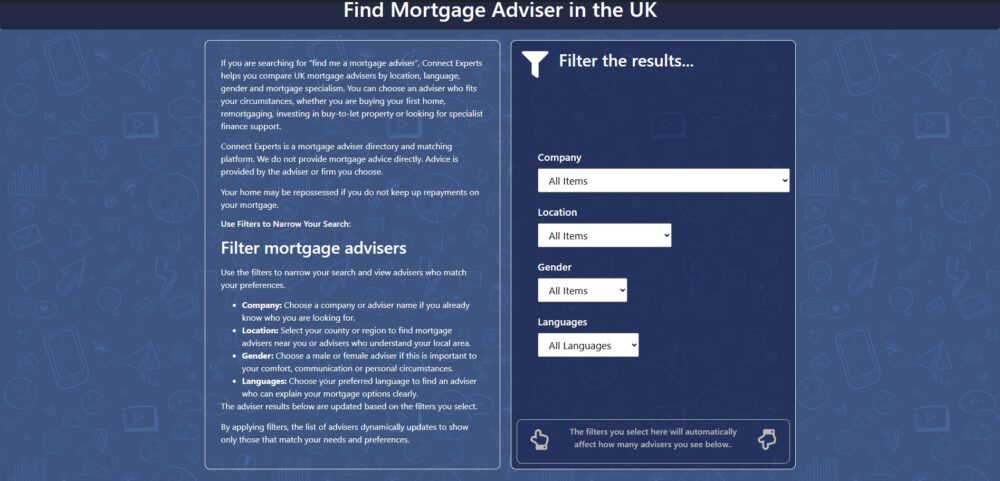
Connect Experts helps you compare mortgage advisers serving South East London and the wider SE postcode area. You can search by mortgage type, location, language, gender preference and specialist experience.
Connect Experts is a mortgage adviser directory and matching platform. It does not provide mortgage advice directly. Advice is provided by the adviser or firm you choose.
Find a Mortgage Adviser who covers South East London and understands your type of mortgage enquiry.
At a Glance
A mortgage broker serving South East London can assess your income, deposit, credit record, property and borrowing purpose before an application is made.
Local property differences may affect lender choice. These can include lease length, service charges, construction type, property use and expected rental income.
You may need advice when:
- buying your first home;
- moving within or into South East London;
- remortgaging an existing property;
- purchasing a buy-to-let;
- applying with self-employed or variable income;
- financing an unusual property;
- reviewing later-life borrowing.
The lowest mortgage rate is not always the lowest-cost option. Fees, term length, early repayment charges and flexibility also matter.
Mortgage Advice Across South East London
South East London includes distinct property markets within Greenwich, Lewisham, Southwark and Bexley.
The wider area contains riverside developments, period terraces, suburban houses, converted flats and large apartment schemes. This variety can influence which lenders will consider a property.
A mortgage broker may help with enquiries across locations including:
- Greenwich
- Woolwich
- Blackheath
- Lewisham
- Deptford
- Catford
- Forest Hill
- Peckham
- Dulwich
- Bermondsey
- Rotherhithe
- Bexleyheath
- Sidcup
- Eltham
- Thamesmead
The adviser does not need to sit within the same postcode. However, they should understand the property type and the lender criteria affecting your application.
How South East London Property Types Affect Mortgages
Mortgage lending is secured against the property. Therefore, a lender considers more than the applicant’s income.
Leasehold apartments
Many apartments across Greenwich, Woolwich, Southwark and Lewisham are leasehold.
A lender may review:
- the remaining lease term;
- ground rent provisions;
- annual service charges;
- planned major works;
- building insurance;
- management arrangements;
- restrictions within the lease.
High service charges can also affect affordability. They form part of the borrower’s ongoing expenditure.
New-build developments
New-build apartments may be subject to different loan-to-value limits. Some lenders also assess incentives offered by the developer.
The lender may want to understand:
- whether the property is newly completed;
- the proposed deposit;
- any cashback or contribution;
- the building’s occupancy level;
- the resale market;
- the warranty provider.
A mortgage agreement in principle does not guarantee acceptance of a particular new-build property.
High-rise buildings
Some lenders apply separate rules to taller apartment blocks.
They may consider:
- construction materials;
- cladding documentation;
- lift access;
- building height;
- the number of storeys;
- commercial use within the development.
Supporting documents may be requested before the lender confirms that the property is acceptable.
Ex-local authority properties
South East London contains many former local authority flats and houses.
Lender criteria may depend on:
- the proportion of privately owned units;
- access arrangements;
- external walkways;
- construction type;
- building height;
- resale demand.
One lender declining a property does not mean every lender will reach the same decision.
Flats above or near commercial premises
A flat above a restaurant, shop or late-night venue may require specialist lender consideration.
The lender may review the commercial activity, noise, access, odours and future saleability.
Period and converted properties
Victorian and Edwardian buildings are common across areas such as Dulwich, Forest Hill, Blackheath and Greenwich.
Converted flats may raise questions about:
- planning consent;
- building regulations;
- separate utilities;
- lease structure;
- soundproofing;
- access;
- freeholder arrangements.
A broker can review likely property concerns before a full application is submitted.
First-Time Buyer Mortgages in South East London
First-time buyers often need to balance property price, deposit size and monthly affordability.
A lender may assess:
- basic salary;
- overtime and bonuses;
- existing loans;
- credit-card balances;
- childcare costs;
- student loan deductions;
- regular household spending;
- the source of the deposit.
Gifted deposits usually require evidence. Lenders may also ask about the relationship between the donor and buyer.
Different lenders can treat variable income, probation periods and recent job changes differently.
Compare first-time-buyer brokers who can explain affordability and lender requirements before you make an offer on a property.
Moving Home Within South East London
Moving home may involve selling one property while arranging finance for another.
The timing can affect:
- the deposit available;
- early repayment charges;
- mortgage portability;
- affordability;
- legal completion;
- temporary borrowing needs.
Porting a mortgage means transferring an existing product to another property. It does not remove the need for a new affordability and property assessment.
The lender may decline the new property or restrict additional borrowing. Therefore, portability should be checked before contracts are exchanged.
Remortgaging a South East London Property
A remortgage can involve moving to another lender. A product transfer usually means selecting a new deal from the existing lender.
The available route may depend on:
- the current mortgage balance;
- the property value;
- the remaining mortgage term;
- income changes;
- credit history;
- early repayment charges;
- additional borrowing needs.
A lower rate may not produce the lowest overall cost when fees are included.
Homeowners can compare remortgage mortgage brokers before an existing deal ends.
Starting early provides time to review valuations, documents, product fees and legal requirements.
Buy-to-Let Mortgages in South East London
South East London attracts landlords because it offers a variety of property types and well-established transport connections.
Buy-to-let applications are usually assessed using expected rental income. Some lenders also require a minimum personal income.
The assessment may include:
- projected monthly rent;
- interest coverage calculations;
- deposit size;
- landlord experience;
- property condition;
- tenancy type;
- ownership structure;
- the wider property portfolio.
A standard buy-to-let mortgage may not be suitable for an HMO or multi-unit property.
Local authority licensing requirements should also be checked before purchase. Mortgage acceptance does not confirm that a property can lawfully be let in the intended way.
Search for buy-to-let mortgage brokers with experience in landlord lending and complex properties.
Mortgages for Self-Employed Applicants
Self-employed applicants are not automatically restricted to specialist mortgages.
However, lenders may calculate income in different ways.
Evidence may include:
- business accounts;
- tax calculations;
- tax year overviews;
- salary and dividends;
- retained profits;
- contracts;
- business bank statements;
- evidence of future work.
A sole trader may be assessed using taxable profit. A limited company director may be assessed using salary and dividends.
Some lenders can consider retained profit, but their rules vary.
Find self-employed mortgage brokers who understand sole traders, directors, contractors and applicants with several income sources.
Credit History and Mortgage Applications
Credit history can affect the lender, rate, deposit and product available.
Relevant issues may include:
- missed payments;
- defaults;
- county court judgments;
- debt-management plans;
- payday loan use;
- high credit utilisation;
- recent mortgage arrears.
The date, value, reason and current status of the issue can all matter.
Applicants should review their credit files before applying. Incorrect records should be challenged with the relevant credit-reference agency.
Several applications in a short period may result in avoidable credit searches. A structured review can reduce poorly targeted submissions.
What a Mortgage Broker Will Usually Review
A broker will normally need enough information to assess affordability and lender eligibility.
This may include:
- proof of identity;
- proof of address;
- bank statements;
- payslips or income evidence;
- deposit evidence;
- details of existing debts;
- current mortgage statements;
- property information;
- credit history;
- future financial plans.
Accurate documents help the adviser identify problems early.
The purpose is not simply to secure an approval. It is to understand whether the mortgage remains manageable after completion.
That distinction matters. Borrowing capacity describes what may be available. Affordability concerns what can be sustained.
Choosing a Mortgage Broker in South East London
A suitable broker should understand both your financial position and your intended property.
Before choosing an adviser, consider:
- Does the adviser cover your mortgage type?
- Do they understand the relevant property?
- Can they explain how they are paid?
- Will they disclose any broker fee?
- Which lenders can they consider?
- How will they communicate with you?
- Who will manage the application?
- What happens if the first lender declines?
You can also ask whether the adviser provides online, telephone or face-to-face appointments.
For general consumer information, read the FCA mortgage guidance before committing to a mortgage.
Later-Life Mortgage Considerations
Older homeowners may wish to review a standard mortgage, retirement interest-only mortgage or equity release.
These options work differently. They can have different affordability tests, payment requirements and long-term costs.
Equity release can affect:
- the value of an estate;
- inheritance;
- future housing choices;
- entitlement to means-tested benefits;
- the total interest owed.
Homeowners considering these options should seek suitable later-life advice.
Find more information through Equity Release Advisers in London.
How to Find a South East London Mortgage Broker
Start by identifying the main purpose of the mortgage.
This may be:
- buying a home;
- moving home;
- remortgaging;
- purchasing a rental property;
- financing a complex property;
- applying with non-standard income.
Next, compare advisers whose experience matches that need.
Review each adviser’s:
- mortgage permissions;
- specialisms;
- location coverage;
- languages;
- appointment options;
- professional profile.
Connect Experts helps you choose who to contact. It does not select a mortgage product or provide personal advice.
Find a Mortgage Broker in South East London
A mortgage decision should account for more than today’s rate.
Property suitability, affordability, fees, flexibility and future plans can all affect whether a mortgage remains appropriate.
Search Connect Experts to compare advisers serving South East London. Choose an adviser whose experience matches your property, income and borrowing purpose.
Frequently Asked Questions
Do I need a mortgage broker based in South East London?
No. The adviser can be based elsewhere if they serve South East London and understand your mortgage needs.
Many mortgage discussions and applications can be completed by telephone or video call.
Which postcodes are covered by South East London?
South East London is commonly associated with the SE postcode area. However, local definitions and borough boundaries do not always match postcode boundaries exactly.
The adviser should confirm that they cover your property location.
Can a broker guarantee that my mortgage will be approved?
No. Mortgage approval remains subject to lender underwriting, affordability checks, credit assessment, valuation and property acceptance.
An agreement in principle is not a formal mortgage offer.
Can I get a mortgage for a South East London flat?
Possibly. The lender may assess the lease, service charges, building construction, property value and resale demand.
High-rise, ex-local authority and new-build flats can require more detailed checks.
Can I use a gifted deposit?
Many lenders accept gifted deposits. However, they usually require identification, bank evidence and a signed declaration from the donor.
The lender and solicitor may also complete anti-money-laundering checks.
How early should I review a remortgage?
It is sensible to begin several months before the current deal ends.
This provides time to compare products, consider fees and prepare documents. The exact period will depend on available lender offers.
Can self-employed people obtain a mortgage?
Yes. Lenders may consider accounts, tax records, contracts, salary, dividends or retained profit.
The required evidence and income calculation vary between lenders.
Does Connect Experts provide mortgage advice?
No. Connect Experts is a directory and matching platform.
Mortgage advice is provided by the adviser or authorised firm you choose.