Mortgage Broker Qualifications UK: A mortgage qualification is evidence of assessed knowledge. It is not a complete measure of an adviser’s suitability for every customer.
Before choosing a mortgage broker, consumers should consider four separate factors:
- Does the adviser hold an appropriate mortgage qualification?
- Does the adviser work through a firm with the correct regulatory status?
- Has the firm assessed the adviser as competent?
- Does the adviser have relevant experience with the required mortgage?
These checks matter because mortgage advice connects formal knowledge with personal circumstances. A qualification establishes a technical foundation. Good advice depends on how that knowledge is applied.
At a Glance
- UK mortgage advisers must meet the qualification and competence requirements relevant to their regulated activities.
- CeMAP is a well-known mortgage qualification, but it is not the only qualification that may be appropriate.
- A qualification does not replace FCA authorisation, firm supervision or ongoing competence.
- The adviser should work through a firm with the correct regulatory status and permissions.
- Check the firm on the FCA Financial Services Register.
- Ask about qualifications, relevant experience, fees, lender access and service scope.
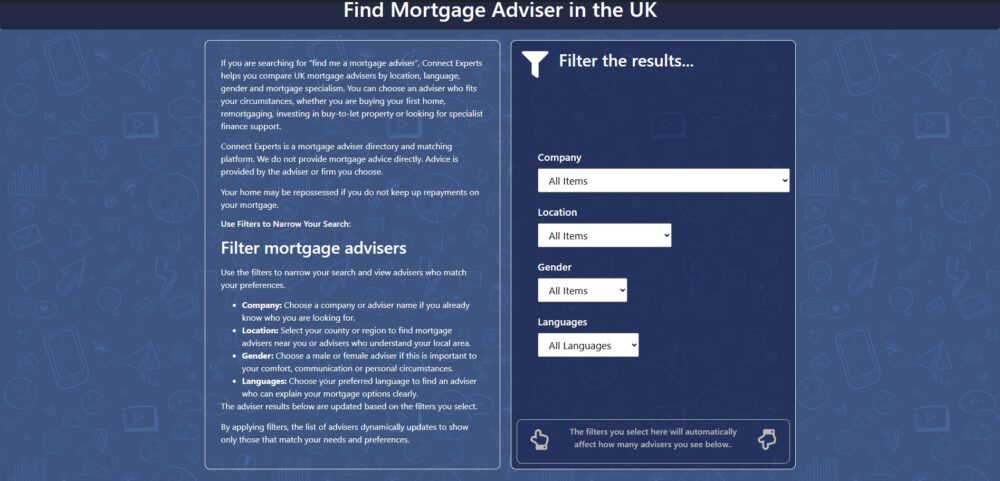
- Connect Experts helps consumers search for mortgage advisers by location, expertise, language and other practical preferences.
- Connect Experts is a directory. Mortgage advice is provided by the adviser or firm selected.
What Qualifications Should a Mortgage Broker Have?
A UK mortgage adviser should hold an appropriate qualification for the regulated mortgage activity they perform.
The qualification should cover relevant technical knowledge, regulation and ethical conduct. The exact requirement can depend on the work undertaken and the qualification’s status within the FCA framework.
CeMAP, the Certificate in Mortgage Advice and Practice, is one of the industry’s best-known mortgage qualifications. However, consumers should not assume that every qualified adviser will hold the same certificate.
The FCA qualification tables include qualifications from several awarding organisations. They also distinguish between currently offered qualifications and older qualifications that remain relevant to people who obtained them during an accepted period.
Consumers can review the FCA’s current appropriate qualification tables for the formal regulatory position.
Is CeMAP the Only UK Mortgage Qualification?
No. CeMAP is widely recognised, but it is not the only qualification that may satisfy the relevant requirements.
An adviser may hold:
- a currently offered mortgage advice qualification;
- an equivalent qualification from another recognised awarding organisation;
- an older qualification accepted under the relevant rules;
- a broader professional qualification containing suitable mortgage advice components;
- further specialist qualifications alongside their core mortgage qualification.
Therefore, seeing different letters after an adviser’s name does not automatically mean one adviser is more qualified than another.
The important questions are:
- Is the qualification appropriate for the work performed?
- Is the adviser working within a properly regulated firm?
- Has the firm confirmed the adviser’s competence?
- Does the adviser have sufficient experience to meet the customer’s needs?
Does Passing an Examination Make Someone a Mortgage Broker?
Passing a recognised examination is an important stage. However, an examination certificate alone does not create an unrestricted right to provide mortgage advice.
The individual normally needs to work through a firm with the relevant regulatory status. The firm must also apply its training and competence procedures before allowing the individual to undertake regulated work without the required supervision.
This distinction protects consumers.
An examination measures knowledge at a point in time. Competence concerns how that knowledge is applied during real customer conversations, research, recommendations and applications.
A newly qualified adviser may therefore receive supervision as they develop practical competence. This does not necessarily mean the adviser is unsuitable. It means the firm is applying oversight while experience is gained.
Qualification, Authorisation and Competence
These terms are related, but they do not mean the same thing.
Qualification
A qualification confirms that the adviser has passed an assessment covering relevant mortgage knowledge, regulation and professional principles.
Regulatory status
The adviser must provide regulated advice through a firm with the appropriate regulatory position.
Consumers can search for FCA-regulated mortgage brokers and then confirm the selected firm’s details through the FCA Register.
Competence
Competence concerns the adviser’s ability to perform their role to the required standard.
The firm may assess competence through:
- supervised customer work;
- case discussions;
- file reviews;
- knowledge testing;
- observed meetings;
- training;
- continuing professional development;
- compliance monitoring.
Permissions and service scope
A firm’s permissions and business scope affect the services it can provide.
An adviser experienced in residential mortgages may not provide all forms of later-life, commercial, or investment advice. Consumers should ask whether the firm handles the exact mortgage or finance requirement involved.
What Does a Mortgage Qualification Cover?
Course content differs between qualifications. However, an appropriate mortgage advice qualification will normally address important areas such as:
- the UK mortgage market;
- mortgage law and regulation;
- the house-buying process;
- mortgage products and repayment methods;
- interest-rate structures;
- affordability;
- income assessment;
- deposits and loan-to-value;
- property ownership;
- taxation principles relevant to the syllabus;
- protection considerations;
- arrears and financial difficulty;
- ethical conduct;
- customer communication;
- suitability and recommendation principles.
Passing the examination shows that the required material has been assessed. It does not show that the adviser has encountered every borrower type, property or lender rule.
That is why relevant practical experience remains important.
Do Mortgage Advisers Need Continuing Professional Development?
Mortgage advisers must maintain the knowledge and competence required for their roles.
Mortgage products, lender criteria, regulation, technology and customer risks change. An adviser’s knowledge must therefore continue developing after the original examination.
Continuing professional development may include:
- regulatory training;
- lender workshops;
- product updates;
- technical reading;
- case reviews;
- compliance briefings;
- vulnerable-customer training;
- fraud prevention;
- data protection;
- complaints analysis;
- professional-body learning.
Consumers do not usually need to inspect an adviser’s complete training record. However, they can ask how the adviser keeps their knowledge current.
The firm remains responsible for applying suitable training and competence controls.
Does a Mortgage Broker Need a Statement of Professional Standing?
A Statement of Professional Standing, often called an SPS, is principally associated with professionals who provide retail investment advice.
A mortgage-only adviser would not normally rely on an SPS as the main evidence of their ability to advise on mortgages.
However, some professionals provide both mortgage advice and investment advice. Such an adviser may hold an SPS due to their broader responsibilities.
For consumers, the more useful mortgage checks are:
- the adviser’s relevant mortgage qualification;
- the selected firm’s FCA Register entry;
- the firm’s permissions and regulatory status;
- the adviser’s experience;
- the service and product range;
- the fees charged.
Do Specialist Mortgages Require Extra Qualifications?
Not every specialist mortgage area has a separate compulsory examination.
However, specialist work may require further knowledge, experience, permissions or internal approval. Requirements depend on the regulated activity and the service provided.
Examples include:
- later-life lending;
- lifetime mortgages;
- second charge mortgages;
- bridging finance;
- commercial mortgages;
- complex buy-to-let;
- high-value borrowing;
- overseas income;
- Sharia-compliant home finance;
- adverse credit;
- development finance.
Consumers should not treat a general mortgage certificate as proof of expertise in every specialist field.
Ask whether the adviser regularly handles comparable cases. Also confirm whether the selected firm provides the required service.
Are Buy-to-Let and Commercial Mortgage Qualifications Different?
The regulatory treatment of buy-to-let and commercial borrowing can differ from standard residential mortgages.
Some buy-to-let transactions may fall within regulated mortgage rules. Others may be treated differently, depending on their purpose and structure. Commercial finance can also involve distinct products, underwriting methods and regulatory considerations.
Therefore, consumers should ask:
- Is this transaction regulated?
- Does the firm handle this form of borrowing?
- What relevant experience does the adviser have?
- Which lenders or providers can the adviser consider?
- What fees apply?
- What protections and complaint routes are available?
The answer should relate to the actual transaction rather than a general description of the adviser’s qualifications.
How Can You Check a Mortgage Broker’s Credentials?
Use several checks rather than relying on one badge, certificate or website statement.
1. Check the firm on the FCA Register
Search for the firm’s legal name or reference number.
Confirm:
- its current status;
- its registered contact information;
- its trading names;
- relevant permissions;
- any important restrictions;
- whether the details match those provided by the adviser.
Be cautious when contact information differs from the official entry. Fraudsters can copy the identity of a genuine business.
2. Ask which firm provides the advice
The adviser should clearly explain the legal identity of the firm responsible for the advice.
The trading name shown on a website may differ from the legal company name. Both should be traceable through the relevant disclosures.
3. Ask about the adviser’s qualification
Ask for the qualification’s full name rather than relying only on initials.
This can help you understand whether it relates to:
- mortgage advice;
- equity release;
- financial planning;
- banking;
- insurance;
- accountancy;
- another professional discipline.
A degree or business qualification may add useful knowledge. However, it does not automatically replace an appropriate mortgage advice qualification.
4. Confirm relevant experience
Ask whether the adviser has handled cases involving similar:
- income;
- employment;
- credit history;
- property type;
- deposit;
- borrowing purpose;
- residency position;
- ownership structure.
Experience should not be treated as a guarantee of acceptance. Lenders make their own decisions and criteria can change.
5. Ask about lender access
The adviser should explain whether their service considers:
- one lender;
- a restricted panel;
- a broad range from the relevant market.
A broader range does not automatically produce a better result. Suitability depends on criteria, costs, features and the borrower’s plans.
Read more about how whole-of-market mortgage brokers describe their lender access.
6. Confirm fees before proceeding
Ask:
- whether an initial discussion is free;
- whether an advice or arrangement fee applies;
- when the fee becomes payable;
- whether another fee applies after completion;
- whether the adviser receives lender commission;
- whether fees are refundable.
The adviser should provide clear information before the customer commits.
What Do the Letters After a Mortgage Adviser’s Name Mean?
Professional letters are called post-nominals. They can indicate qualifications, memberships or professional status.
They may relate to:
- mortgage advice;
- financial advice;
- equity release;
- banking;
- insurance;
- accounting;
- business;
- academic study.
Post-nominals can provide useful context, but they should not be read as a ranking system.
A longer list of letters does not prove that an adviser is better suited to a particular customer. Relevance matters more than quantity.
Consumers should ask what an unfamiliar qualification means and how it relates to the advice required.
Does the FCA Approve Individual Mortgage Brokers?
Consumers often use phrases such as “FCA-approved mortgage broker”. However, regulatory terminology requires care.
The FCA Register is the primary place to check firms, individuals where recorded, trading names and regulatory information. The exact entry available will depend on the person’s role and the firm’s structure.
Consumers should avoid relying on an FCA logo, an unlinked register number or a general claim of approval.
Instead:
- Open the FCA Register independently.
- Search for the firm.
- Compare the legal name and reference number.
- Check the registered telephone number and website.
- Review the available regulatory information.
- Contact the firm using verified contact details if anything appears inconsistent.
How Connect Experts Helps You Find a Qualified Adviser
Connect Experts is a UK mortgage adviser directory and matching platform.
It helps consumers search for advisers using practical criteria, including:
- location;
- mortgage type;
- professional expertise;
- language;
- gender;
- company or adviser name;
- communication preference.
You can use the mortgage broker directory to identify advisers whose services appear relevant to your circumstances.
Connect Experts does not provide mortgage advice directly. Advice is provided by the adviser or firm selected.
Directory information can support your initial research. It should be combined with FCA checks and a direct discussion with the adviser.
Questions to Ask Before Choosing a Mortgage Adviser
Ask the following before proceeding:
- Which mortgage qualification do you hold?
- Which regulated firm will provide the advice?
- Where can I verify the firm’s status?
- Do you regularly advise on cases like mine?
- Which mortgage areas do you cover?
- Are any services outside your scope?
- How broad is your lender access?
- Which direct-only products cannot you consider?
- What fees will I pay?
- When do fees become payable?
- Do you receive lender commission?
- How will you explain your recommendation?
- Who handles my case when you are unavailable?
- How can I complain if something goes wrong?
Clear answers are often more useful than a long collection of certificates.
Frequently Asked Questions
What is the main qualification for a mortgage broker in the UK?
CeMAP is one of the most widely recognised UK mortgage advice qualifications. However, other current and historic qualifications may also meet the relevant requirements.
Can someone give mortgage advice after passing CeMAP?
Passing CeMAP demonstrates assessed knowledge. The individual must also provide regulated advice through an appropriate firm and meet that firm’s competence requirements.
Should I ask to see a broker’s certificate?
You can ask about the qualification and awarding organisation. You should also verify the selected firm’s regulatory status through the FCA Register.
Is experience more important than qualifications?
They serve different purposes. A relevant qualification establishes technical foundations. Experience helps an adviser apply knowledge to real cases. Consumers should consider both.
Are all mortgage brokers qualified to advise on equity release?
No. Later-life and equity-release advice can involve separate qualification and competence requirements. Ask specifically whether the adviser and firm provide that service.
Does a degree make someone a qualified mortgage broker?
Not by itself. A degree may provide useful knowledge, but the adviser must meet the qualification requirements relevant to regulated mortgage advice.
Are mortgage brokers regulated as individuals or firms?
Regulatory arrangements differ by role and business structure. Consumers should identify the firm responsible for the advice and verify its details through the FCA Register.
Does Connect Experts recommend one mortgage broker?
Connect Experts helps users search for advisers. It does not rank advisers or recommend a mortgage product. The user chooses which adviser or firm to contact.
A Qualification Is the Beginning, Not the Entire Test
Professional qualifications matter because mortgage advice can affect a household for many years.
However, competence is not limited to a single certificate. It develops through supervision, practice, technical learning and accountable conduct.
For consumers, the sensible approach is not to choose between qualifications and experience. It is to verify both, confirm the firm’s regulatory position and ask whether the adviser’s work fits the mortgage required.
Finding an Adviser Through the Directory
Start by defining the mortgage need.
For example, consider whether you require support with:
- a first home;
- moving home;
- remortgaging;
- self-employed income;
- buy-to-let;
- adverse credit;
- an HMO;
- a limited company;
- commercial property;
- bridging finance;
- later-life borrowing.
You can then find a mortgage adviser in the UK and review advisers with relevant services.
Before making contact:
- read the adviser profile;
- check the firm’s regulatory details;
- note the listed qualifications;
- confirm relevant experience;
- prepare questions about fees and lender access.
A directory helps organise the search. The final decision should depend on verified information and the quality of the initial discussion.