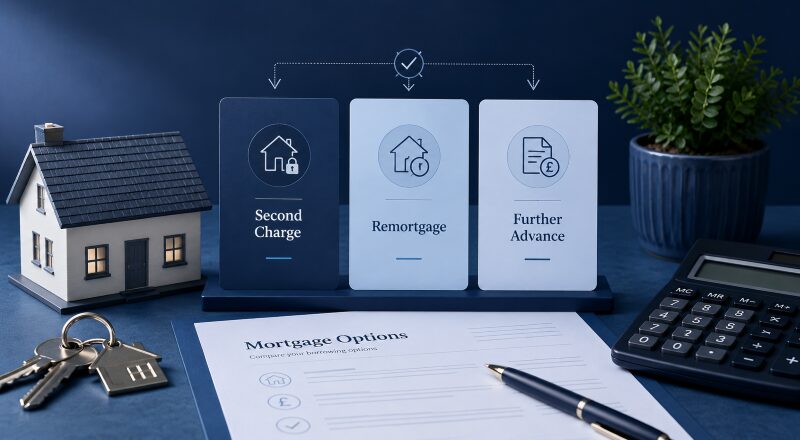
Second Charge vs Remortgage or Further Advance: A remortgage replaces the existing mortgage. A further advance adds borrowing from the current lender. A second-charge mortgage creates a separate secured loan.
The right option depends on rates, fees, equity, affordability and future plans.
Second Charge Mortgage, Remortgage or Further Advance?
Homeowners raising money from a property usually meet three possible routes.
They may remortgage, request a further advance or arrange a second-charge mortgage.
Each method can release funds. However, they do not produce the same financial structure.
The decision is not simply about which rate looks lowest. It concerns which parts of the existing arrangement should remain untouched.
How does a remortgage work?
A remortgage normally replaces the current first mortgage.
The new borrowing repays the existing lender. Any extra amount is then released for the agreed purpose.
This can combine the borrowing into one mortgage payment.
However, the borrower may:
- Lose an existing fixed rate.
- Pay an early repayment charge.
- Incur valuation, legal or product fees.
- Move the full mortgage balance onto a new rate.
- Extend the repayment period.
Someone approaching the end of a current deal may find remortgaging easier to justify than someone who has several fixed-rate years remaining.
A remortgage mortgage broker can explain the available routes.
What is a further advance?
A further advance is additional borrowing from the existing first mortgage lender.
It normally sits with the main mortgage, although the extra borrowing may have a different rate or end date.
The current lender will assess:
- Income.
- Expenditure.
- Credit history.
- Property value.
- Existing mortgage balance.
- Purpose of borrowing.
- Overall affordability.
A further advance may be convenient. However, the existing lender’s criteria and products limit the available choice.
How does a second charge differ?
A second-charge mortgage is a separate loan secured behind the first mortgage.
The first mortgage remains in place.
This can be relevant where:
- The existing rate is competitive.
- A large early repayment charge applies.
- The current lender declines further borrowing.
- The borrower’s circumstances have changed.
- A different repayment term is required.
- The existing mortgage contains valuable features.
The second-charge lender will assess equity, affordability and the existing secured commitments.
MoneyHelper explains that second mortgages use the home as security and should be compared with personal loans and remortgaging.
Read its independent guide to second-charge or second mortgages.
Comparison table
| Feature | Remortgage | Further advance | Second charge |
|---|---|---|---|
| Existing mortgage | Replaced | Retained | Retained |
| Lender | Existing or new | Existing lender | Usually another lender |
| Number of secured loans | Usually one | One lender with extra borrowing | Two separate loans |
| Early repayment charge risk | Possible | Usually avoided on main loan | Usually avoided on main loan |
| Product choice | Wider mortgage market | Existing lender only | Specialist second-charge market |
| Separate payment | Usually no | Product dependent | Usually yes |
| Separate term | Not normally | Possible | Yes |
Which option may suit a fixed-rate borrower?
Suppose the existing mortgage has a low fixed rate and a substantial early repayment charge.
Replacing the entire balance could increase costs. A second charge may allow the existing deal to remain.
However, the second-charge rate may be higher.
The adviser must compare the cost of:
- Keeping the first mortgage.
- Paying two secured loans.
- Replacing the first mortgage.
- Waiting until the fixed period ends.
- Using a further advance.
A product cannot be judged separately from what it preserves or replaces.
What should be compared?
Request a written comparison covering:
- Monthly repayments.
- Initial fees.
- Early repayment charges.
- Total amount repayable.
- Fixed and variable rate periods.
- Mortgage terms.
- Overpayment options.
- Future remortgage plans.
- Plans to move home.
- The effect of adding fees to the balance.
The comparison should use consistent loan amounts and realistic repayment periods.
Finding suitable advice
The Second Charge Mortgage Guide explains the general structure of second-charge borrowing.
After reviewing the guide, use the second mortgage loan adviser results to compare advisers.
Connect Experts helps users find advisers. The mortgage recommendation comes from the adviser or firm selected.
FAQ
Does a second charge replace my mortgage?
No. It normally runs alongside the existing mortgage.
Is a further advance always cheaper?
No. Costs depend on the rate, fees, term and lender criteria.
Can I remortgage while a second charge exists?
Potentially. The second charge may need to be repaid, retained or postponed behind the new first mortgage.
Which option has the lowest rate?
That depends on the application and market. The lowest rate may not produce the lowest overall cost.
Should I compare all three options?
Where they are available, comparing them can support a clearer decision.
Next step
Do not compare products in isolation. Compare what each product changes.
Find second mortgage loan advisers who can assess second-charge borrowing against other available routes.