How to Choose the Right Mortgage Broker in the UK: A mortgage broker should be selected for the quality and suitability of their service, not for a headline rate or sales promise.
The right broker should understand your circumstances, hold the correct regulatory permissions and explain their service before making a recommendation. Their lender access, fees, specialist experience and communication process should also be clear.
Choosing carefully matters because two brokers may assess the same application differently. They may use different lenders, interpret criteria differently or provide different levels of support.
At a Glance
Before choosing a mortgage broker in the UK, check:
- The adviser’s firm and regulatory status
- Whether the firm has the correct mortgage permissions
- The range of lenders and products considered
- Experience relevant to your circumstances
- All fees, commission and additional mortgage costs
- How recommendations will be researched and explained
- Who will manage your application after submission
- Whether ongoing support is included
Do not choose solely by broker fee, location, review score or an advertised rate. The central question is whether the broker can provide suitable regulated advice for your circumstances.
What Does a Mortgage Broker Do?
A mortgage broker assesses your financial position before recommending a suitable mortgage.
The assessment will usually include:
- Income and employment
- Deposit or available equity
- Credit commitments
- Credit history
- Household spending
- Property type
- Mortgage term
- Repayment method
- Future plans
- Attitude towards payment changes and financial risk
The broker may then compare mortgage options from the lenders available through their service.
Read more about what a mortgage broker does before comparing individual advisers.
A broker does not control a lender’s decision. The lender will complete its own affordability, credit, property and policy checks.
Check the Broker’s Regulatory Status
The first practical check is whether the firm has permission to provide the service you need.
A mortgage adviser may work for an FCA-authorised firm or through an appointed representative arrangement. The trading name on a website may also differ from the firm’s legal name.
Check:
- The legal name of the firm
- Its Financial Services Reference number
- Whether it is authorised or an appointed representative
- The name of its principal firm, where applicable
- Whether its permissions cover regulated mortgage advice
- Whether the telephone number and website match the official record
The FCA explains how to check whether a firm or individual is authorised.
You can also read about FCA-regulated mortgage brokers and why regulatory status matters.
Do not rely only on a badge, logo or statement displayed on a website. Clone firms can copy genuine regulatory details while using different contact information.
Check the Adviser’s Qualifications and Role
A mortgage adviser should hold an appropriate recognised qualification and meet the competence requirements applying to their role.
However, a qualification alone does not confirm:
- Current regulatory status
- The firm’s permissions
- Relevant specialist experience
- The range of lenders available
- The quality of the advice process
Ask who will provide the regulated advice. You should also establish whether another employee will manage the application after it has been submitted.
Our guide to mortgage broker qualifications explains the differences among professional knowledge, regulatory status, and practical experience.
Does Whole-of-Market Access Matter?
The phrase “whole of market” is often used in mortgage advertising. Consumers should ask what it means within the broker’s actual service.
A broker may consider:
- A broad range of lenders
- A selected panel of lenders
- Specialist lenders
- Building societies
- Lenders available only through intermediaries
- Products from one lender or banking group
Ask the broker:
- Which lenders can you consider?
- Are any lenders or product types excluded?
- Do you work from a restricted panel?
- Can you access specialist lenders?
- Are direct-only mortgage products outside your service?
- Does your range cover my type of application?
A wider range of lenders can be useful. However, suitability also depends on the broker’s understanding of your income, property, and borrowing needs.
Read how whole-of-market mortgage brokers may differ from restricted services.
Choose Experience Relevant to Your Circumstances
A broker’s general experience may not be enough when an application involves specialist criteria.
Relevant experience can be important for:
- Self-employed applicants
- Contractors and freelancers
- Company directors
- Applicants with variable income
- Applicants with previous credit problems
- First-time buyers
- Older borrowers
- Portfolio landlords
- Houses in multiple occupation
- Limited company buy-to-let
- Expat or overseas income
- Unusual construction
- Commercial property
- Bridging or development finance
Ask how the broker has handled circumstances similar to yours. They should be able to explain the factors lenders usually assess without promising an approval.
For a more focused search, use the option to find a broker by expertise.
Compare Mortgage Broker Fees Properly
Mortgage brokers may receive lender commission. Some also charge a client fee.
Before proceeding, request a written explanation covering:
- The amount of the broker fee
- Whether the fee is fixed or percentage-based
- When the fee becomes payable
- Whether the fee is refundable
- Whether another fee applies if the first application fails
- Whether future mortgage reviews carry a new fee
- Whether the broker receives lender commission
- Whether cancellation charges apply
Do not compare broker fees in isolation.
A mortgage can also include:
- Product fees
- Valuation charges
- Legal costs
- Application fees
- Higher lending charges
- Early repayment charges
- Account fees
- Telegraphic transfer charges
A lower rate can sometimes come with a higher product fee. A suitable comparison should therefore consider the total cost over the relevant period.
Ask How the Broker Assesses Suitability
A regulated recommendation should be based on more than the lowest initial interest rate.
The broker should consider:
- Monthly affordability
- Total cost
- Initial mortgage period
- Mortgage term
- Fixed, variable or tracker features
- Early repayment charges
- Overpayment rules
- Portability
- Product fees
- Repayment method
- Future income changes
- Plans to move or refinance
- Your need for payment certainty
Ask how the broker will explain the reason for their recommendation.
You should receive enough information to understand:
- Why the recommended mortgage may suit you
- Which important alternatives were considered
- The main costs and restrictions
- What could cause payments to change
- What happens when the initial deal ends
A recommendation should be understandable without relying on sales language.
Review the Communication and Application Process
Advice quality and case administration are related, but they are not identical.
Ask:
- Who will be my main contact?
- How are documents collected?
- How quickly are queries normally answered?
- Who contacts the lender?
- Will you communicate with the estate agent and solicitor?
- How will I receive updates?
- What happens if the lender requests more evidence?
- Will you check the mortgage offer?
- Is support included through to completion?
A broker may provide advice personally and then transfer administration to a case manager. This can work well when responsibilities are clearly explained.
Problems often arise when the borrower does not know who is responsible for the next step.
Is a Local Mortgage Broker Necessary?
A local broker is not always essential.
Many advisers provide regulated mortgage advice by telephone or video. Remote advice may offer broader access to specialist experience and flexible appointment times.
A local adviser may still be useful when:
- You prefer face-to-face meetings
- The property market has unusual local features
- You need help understanding regional buying processes
- Local property types require specialist lender knowledge
- You want appointments near your home or workplace
Location should not replace checks on regulation, permissions, expertise or lender access.
Consider Language and Accessibility Needs
Mortgage advice involves technical terms, legal documents and long-term financial commitments.
Ask whether the adviser can support:
- Your preferred language
- Telephone, video or face-to-face meetings
- Hearing or visual accessibility needs
- Digital or paper documents
- Additional time to review information
- A trusted person attending meetings
Clear communication is part of informed decision-making. A borrower should not feel pressured to accept information they do not understand.
Use Reviews Carefully
Reviews can provide information about communication, responsiveness and administration. However, they do not prove that a recommendation will be suitable for your circumstances.
When reading reviews, consider:
- Whether the platform verifies reviewers
- How recent the reviews are
- Whether comments contain specific service details
- How the firm responds to complaints
- Whether every review uses similar wording
- Whether the review concerns the adviser or the wider firm
Do not send sensitive financial documents through an unverified link because a review or social media account appears convincing.
Warning Signs When Choosing a Broker
Pause before proceeding when a broker:
- Guarantees approval before completing an assessment
- Promises access to a rate without checking eligibility
- Avoids explaining fees
- Refuses to identify the regulated firm
- Uses contact details that differ from the FCA record
- Encourages you to hide debts or credit problems
- Suggests changing income documents
- Pressures you to apply immediately
- Cannot explain why a mortgage may suit you
- Requests payments to an unexplained personal account
- Makes claims about “exclusive” products without evidence
A professional broker should explain uncertainty. Lender criteria, valuations and underwriting decisions can change the outcome of an application.
Questions to Ask a Mortgage Broker
Use these questions during your first conversation:
Regulation
- Which authorised firm provides the advice?
- Are you directly authorised or an appointed representative?
- What is the firm’s FCA reference number?
- Does the firm have permission for my type of mortgage?
Lender access
- Which lenders can you consider?
- Is your service whole of market or panel-based?
- Are direct-only products excluded?
- Can you use specialist lenders?
Experience
- Do you regularly advise people in my circumstances?
- Have you handled this type of income or property before?
- What evidence may lenders request?
- Which parts of my case could limit lender choice?
Costs
- What broker fee will I pay?
- When does it become payable?
- Is any part refundable?
- Will you receive lender commission?
- What other mortgage costs should I expect?
Service
- Who will provide the advice?
- Who will manage the application?
- How will you update me?
- Will you review the mortgage offer?
- Does your support continue until completion?
Recommendation
- How will you compare suitable products?
- Will you explain the total cost?
- Which restrictions should I understand?
- Why does the recommendation meet my needs?
A Practical Mortgage Broker Comparison Checklist
Before making your final choice, compare each broker against the same criteria.
| Check | Broker one | Broker two | Broker three |
|---|---|---|---|
| Regulatory status confirmed | |||
| Correct permissions confirmed | |||
| Relevant specialist experience | |||
| Lender range explained | |||
| Excluded products explained | |||
| Broker fee confirmed | |||
| Commission explained | |||
| Application support explained | |||
| Communication method agreed | |||
| Recommendation process explained |
This method creates a fairer comparison than choosing from one advertisement or review score.
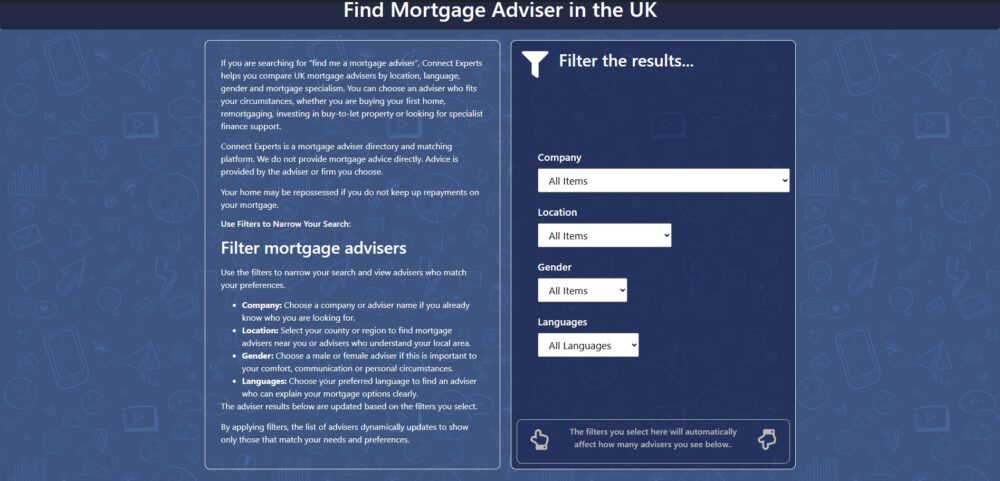
How Connect Experts Helps You Search
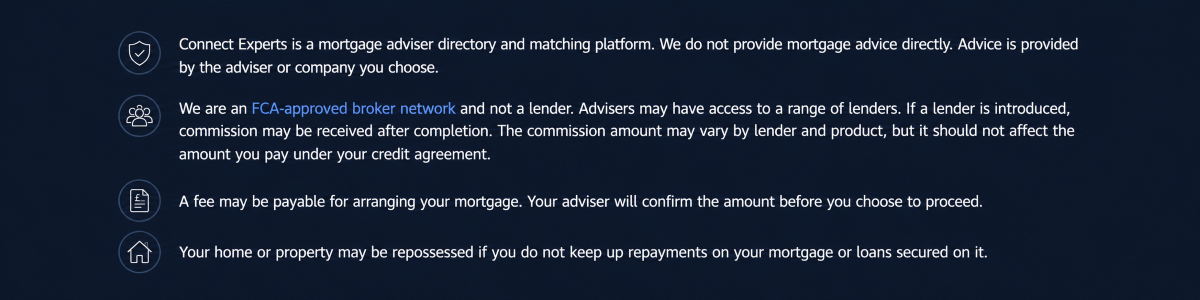
Connect Experts is a mortgage adviser directory and matching platform. It does not provide mortgage advice directly.
You can search for advisers by factors such as:
- Mortgage type
- Specialist experience
- Location
- Language
- Gender
- Communication preference
Advice is provided by the adviser or firm you select. You should still check the firm’s regulatory status, permissions, fees and service before proceeding.
Search the UK mortgage adviser directory when you are ready to compare advisers.
Frequently Asked Questions
What is the most important check when choosing a mortgage broker?
Confirm which firm provides the regulated advice and check its status and permissions. Then assess whether the broker has suitable experience for your mortgage needs.
Should I choose the mortgage broker with the lowest fee?
Not automatically. Compare the broker fee alongside product costs, lender access, service and the suitability of the recommendation.
Is a whole-of-market mortgage broker always better?
A broad lender range can provide more choice. However, the broker must also understand your circumstances and have access to lenders suitable for your needs.
Can a mortgage broker guarantee an application?
No broker controls the lender’s final decision. Approval remains subject to affordability, credit, property, valuation and underwriting checks.
Should I use a local or online mortgage broker?
Either may be suitable. Choose according to regulatory status, experience, service and communication needs rather than location alone.
How many mortgage brokers should I speak to?
There is no required number. Speaking to two or three brokers may help you compare fees, lender access and service before choosing one.
Can I change mortgage brokers?
You may be able to change brokers, but check any fee agreement already accepted. You should also avoid submitting unnecessary duplicate applications.
Choosing with Evidence Rather Than Promises
The right mortgage broker is not necessarily the nearest, cheapest or most heavily advertised.
A sound choice comes from checking facts:
- Who provides the advice
- What the firm is permitted to do
- Which lenders can be considered
- What the service will cost
- Whether the broker understands your circumstances
- How the recommendation will be explained
A mortgage is a long-term financial commitment. Taking time to examine the advice process before discussing products can prevent confusion later.