Mortgage Broker in Monmouth searches often begin with a price, but the property itself can quickly become just as important.
Monmouth contains a historic town centre shaped by medieval street patterns and longstanding buildings, while newer housing continues to extend parts of the town. That difference matters because lenders assess both the borrower and the property offered as security.
Someone buying an established home near Monnow Street may therefore face different questions from someone purchasing a newer property around the town’s developing residential areas.
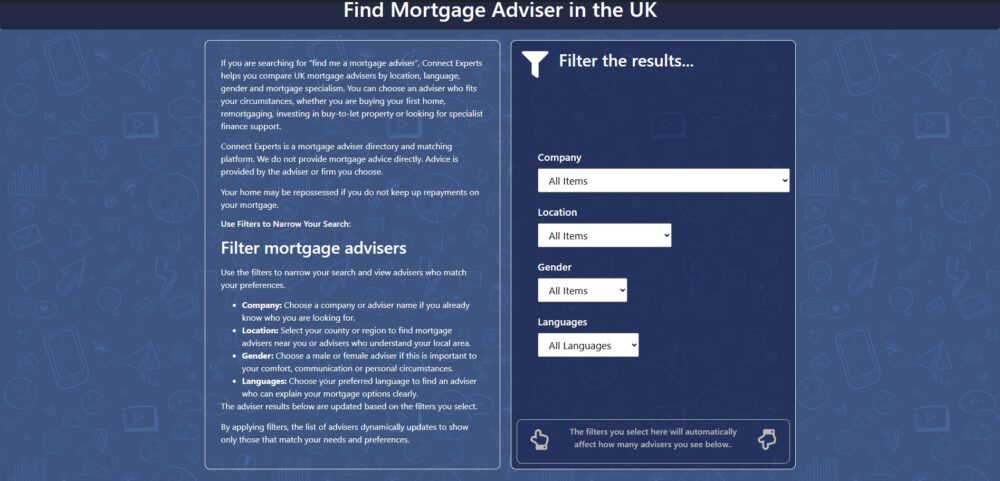
Connect Experts helps you search for mortgage advisers by location, mortgage requirement and other available preferences. It is a mortgage adviser directory and matching platform. Mortgage advice is provided by the adviser or firm you choose.
Monmouth sits within Wales’s highest-priced local authority
Price doesn’t tell you everything about a mortgage, but it sets the scale of the decision.
The Office for National Statistics recorded an average Monmouthshire house price of £335,000 in July 2026. That was the highest local-authority average in Wales at the time. These are county figures rather than Monmouth town prices, so they should not be treated as a valuation of an individual property.
The same ONS data showed significant differences by property type within Monmouthshire:
- detached homes averaged £499,000;
- semi-detached homes averaged £302,000;
- terraced homes averaged £237,000;
- flats and maisonettes averaged £152,000.
That spread helps explain why a search for mortgage advice in Monmouth cannot be reduced to one typical borrower.
A buyer’s borrowing requirement may change substantially according to the home they choose.
For mortgage purposes, lenders can consider income, expenditure, existing debts, deposit, mortgage term and loan-to-value. Property suitability and valuation also remain important.
Historic Monmouth can make the property part of the mortgage question
Monmouth’s historic character is not simply a tourism description.
Monmouthshire County Council has a formal Monmouth Conservation Area, while its appraisal records surviving medieval plot patterns and a substantial collection of historic buildings around areas such as Monnow Street.
That does not mean an older property will be difficult to mortgage.
It does mean buyers should understand what they are purchasing.
Depending on the individual building, a lender or valuer may consider matters such as:
- construction type;
- condition;
- alterations;
- marketability;
- access;
- any unusual building characteristics;
- whether the property provides suitable security for the loan.
A mortgage valuation is primarily carried out for the lender. It is not the same as a detailed structural survey.
For someone buying an older or unusual home, this distinction matters. A property can have considerable character while still raising practical questions about condition, valuation or future maintenance.
The property’s age should therefore inform the due diligence, rather than determine the mortgage outcome by itself.
First-time buyers face a higher local entry point
For someone buying their first home, the hardest number is often not the mortgage rate. It is the amount they must borrow in the first place.
ONS figures show that first-time buyers across Monmouthshire paid an average of £270,000 in July 2026, compared with £257,000 across Wales. Again, this is a county-wide average, not a Monmouth-specific asking price.
A first-time buyer considering Monmouth may therefore want to understand how changing the deposit affects loan-to-value and potential lender choice.
For example, the discussion may cover:
- the deposit available;
- income and regular expenditure;
- credit commitments;
- mortgage term;
- whether funds are being gifted;
- the type and condition of the chosen property.
First-time buyers can search for a first-time buyer mortgage adviser and compare adviser profiles before deciding who to contact.
The objective is not simply to establish the maximum possible loan.
A more useful question is whether the mortgage, property and wider household costs can work together over time.
Monmouth is also changing at its edges
Monmouth’s housing story is not entirely historic.
The adopted Monmouthshire Local Development Plan allocated the Wonastow Road site for mixed residential and employment development. The original allocation provided for around 450 homes. More recent council housing work records a remaining Wonastow Road allocation within current planning work.
This provides an important contrast within one town.
A buyer can move from medieval street patterns and established housing to comparatively modern development within a relatively short distance.
New-build and recently built properties can raise their own mortgage questions. Depending on the property and lender, these may include:
- deposit requirements;
- loan-to-value limits;
- valuation;
- incentives offered by a developer;
- completion timescales;
- estate charges or management arrangements.
This is why property type can be as important as postcode.
Monmouth doesn’t have a single mortgage scenario. It contains housing from very different periods, and lender criteria can differ accordingly.
The road connection matters, but it should not drive the mortgage
Monmouth has no mainline railway station, so road access is particularly important.
The A40 passes the town and connects into the wider A40/A449 trunk-road network through Monmouthshire. Welsh Government road orders confirm the A40 and A449 as the trunk-road corridor between the Wales-England border and the Coldra Interchange near Newport.
That may influence where someone chooses to live, particularly where work or family commitments involve travel outside Monmouth.
However, access should form part of the wider household calculation.
A purchaser might reasonably compare:
- mortgage payments;
- commuting or travel costs;
- household bills;
- property maintenance;
- childcare or education costs;
- other committed expenditure.
A house can fit the mortgage calculation while the overall lifestyle budget feels less comfortable.
Mortgage affordability and personal affordability are related, but they are not the same question.
Where education forms part of the household budget
Monmouth also has a direct connection with independent education through Haberdashers’ Monmouth School, which is based within the town.
For households paying independent-school fees, those costs can factor into broader financial planning alongside housing costs.
This does not mean education should dictate the mortgage. It means you should consider recurring commitments honestly before deciding what level of borrowing feels sustainable.
Homeowners specifically considering property and borrowing in connection with school costs can read about Education Finance.
When an existing Monmouth mortgage reaches its next decision point
Not every search for a mortgage adviser begins with a property purchase.
An existing homeowner may simply be approaching the end of a fixed, tracker or discounted mortgage deal.
Time changes more than mortgage rates.
Since the original mortgage began, the borrower may have changed jobs, become self-employed, had children, taken on additional borrowing, or reduced the mortgage balance.
The property may also have changed in value or condition.
When a new lender assesses a remortgage, it considers the current circumstances rather than the circumstances under which the original loan was approved.
Homeowners approaching the end of a current deal can therefore use the mortgage rate ending adviser search to compare advisers with relevant experience.
A product transfer with the existing lender may also be available in some circumstances. An adviser can explain the differences before you decide how to proceed.
Protecting the commitment behind the property
Buying a property creates an asset, but it can also create a long financial commitment.
For some households, it is sensible to consider what would happen to mortgage payments if death, serious illness or an extended period away from work reduced household income.
The appropriate discussion may include life cover, critical illness cover or income protection, depending on personal circumstances and adviser permissions.
Protection should not be based solely on mortgage size.
Income, savings, dependants, existing workplace benefits and other commitments may all matter.
Connect Experts also provides a directory for people wanting to compare protection mortgage brokers.
What should you look for in a Monmouth mortgage adviser?
Being close to Monmouth can help, especially if you prefer face-to-face meetings.
That shouldn’t be the only test.
For a Monmouth property, consider whether the adviser has experience relevant to:
- your residential or investment mortgage requirement;
- your income structure;
- the deposit available;
- the property’s age and construction;
- first-time buyer or home-mover cases;
- remortgaging, where relevant;
- the lender criteria likely to affect your circumstances.
You may also want to confirm fees, lender access and whether meetings are offered face-to-face, online or by telephone.
Connect Experts lets users compare advisers rather than assigning one person simply because they appear closest geographically. The directory can be searched by location, mortgage type, language and other available preferences.
The relevant county journey is Mortgage Brokers in Monmouthshire, not the Midlothian page supplied in the brief.
A Monmouth mortgage decision can involve a centuries-old home, a newer development, or something in between. The useful adviser is therefore the one whose experience fits the borrower and the property, not simply the postcode.
Find an Adviser for Your Monmouth Property
Use the Connect Experts mortgage adviser directory to compare advisers by location and relevant mortgage experience, then choose who you would like to contact.